I read somewhere that Basbousa, in Arabic, means “just a kiss.” So that’s cute. “Just a kiss cake.” It goes by many other names, as well, Namourah, Harisseh, Revani/Ravani and Sooji. If that’s any indication how delicious it is, lots of different countries have claimed it as their own.

Basbousa is honestly one of the tastiest desserts I’ve ever had, and I’m strictly a chocolate girl. It’s just so sweet and fragrant and the syrup oozes down your tongue by surprise, how can a girl resist? It’s no small factor that it’s also incredibly simple to make and requires almost no attention. Plus, it’s totally versatile. You can make bite-sized chocolate, coconut covered squares, or even cupcakes without screwing up the recipe. You can put ricotta cheese or nuts in between the layers, you can play with the proportions and you can top it with any nuts or garnish you want. Despite including healthier proportions in this recipe, it’s still perfectly fluffy, dripping with sweetness and 30 times more enjoyable because you won’t feel weighed-down after eating it. My grandpa likes it for breakfast!

I’m still trying to play with making the ingredients even healthier, so I’ll post an update soon. I made it once with no dairy at all, but I have to find where I left the recipe.

What you need:

1/2 c unsalted butter (you could substitute oil for this, or reduce it to 1/4, but if you do, increase the yogurt to 1 cup)

1/2 c sugar

1 tsp vanilla extract

2 eggs

2 c semolina

1 tsp baking powder

3/4 c plain yogurt (though vanilla would probably be delicious)

1/2 c ground, unsweetened coconut (optional. this can go inside the batter or sprinkle some on top for garnishing.)

about 15 slivered, halved or whole almonds for topping (I’ve also used pistachio before)

For the syrup:

1/2 cup sugar

1 c water

2 tsp lemon juice

up to 2 tblsp rose water (this is really dependent upon your taste, but if you are using undiluted rosewater, just 2-3 drops)

This cake cooks perfectly as a cake; as these bite-sized chocolate, coconut covered squares; or even as cupcakes.

How to do it:

Preheat your oven to 300 F. The first thing you’ll want to do is make the syrup. Pour the water and sugar into a pot and bring to a boil and let boil for about 5 minutes. Once the sugar has dissolved, add the lemon juice and then let simmer for another five minutes. After those ten minutes, add the rose water, stir and remove from the heat. Pour the syrup into a bowl and place that bowl into a larger bowl filled with cold water in the fridge. Then take it out once your cake has cooked. The syrup should be somewhat thickened.

Combine butter, sugar and vanilla until somewhat fluffy. Add the eggs one at a time and beat each one well before adding the next. The semolina and baking powder should be mixed together separately and then slowly added to the butter batter, alternating with the yogurt.

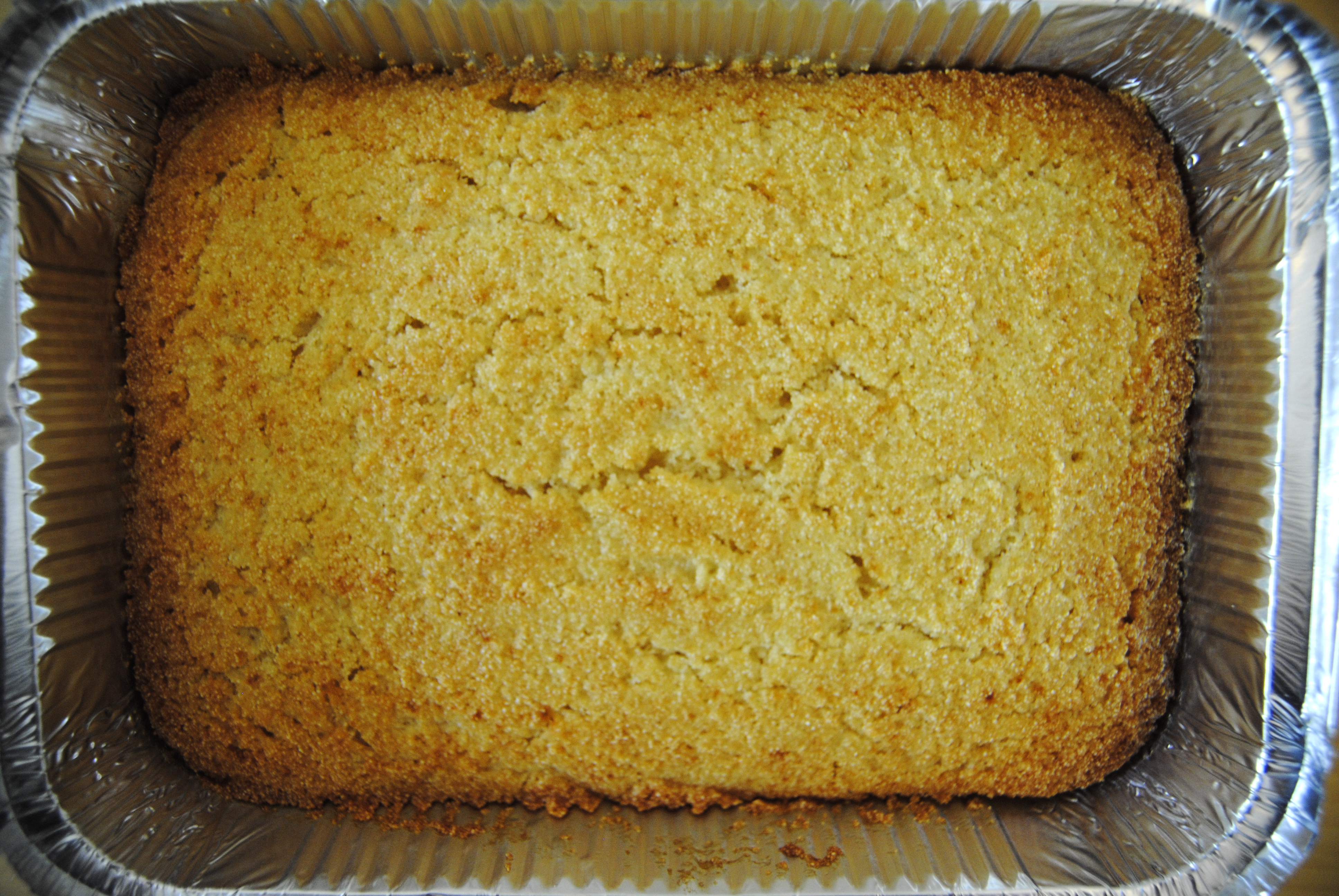
Once combined, pour the batter into a 7 x 11 baking tray (or whatever you have, just make sure that cake will get tall and not spread out thin) and place the almonds on top of the batter and spread them out so that when you cut the cake each slice has its own almond either resting flat or sticking up straight if your using slivers. Cook for 35-40 minutes but check at 30 minutes. The cake is done when it has a goldeny top.

Now, pour the cooled syrup all over the hot cake and let it sit for about 15 minutes so it can soak up all the sweet, sugary amazing-ness. Then you can cut it into squares or diamonds and serve!


Don’t you just want to roll around in a bed of coconut? Yeah, nope, I don’t want to either. But I don’t mind if my chocolate does! Oh my god, these were so fun to make! I took my version of Basbousa Cake (an Egyptian/Lebanese/Syrian/Greek semolina cake soaked in rose water scented syrup), minus the syrup, and cut it into bite-sized squares, dipped them in melted dark chocolate and rolled them in shredded coconut. They were perfectly sweet, light, and fluffy and went amazingly with tea, my diet, and each layer felt like its own distinctive treat. I will definitely make these again and they were gone in minutes!

What you need:

1/2 c unsalted butter (you could substitute oil for this, or reduce it to 1/4, but if you do, increase the yogurt to 1 cup)

1/2 c sugar

1 tsp vanilla extract

2 eggs

2 c semolina

1 tsp baking powder

3/4 c plain yogurt (though vanilla would probably be delicious)

1 bag of dark chocolate chips (or any other form of chocolate you like)

2-3 cups of ground coconut (you wont use this much but having extra around makes coating them much easier)

Makes 24 small little guys

How to do it:

Combine butter, sugar and vanilla until somewhat fluffy. Add the eggs one at a time and beat each one well before adding the next. The semolina and baking powder should be mixed together separately and then slowly added to the butter batter, alternating with the yogurt.

Once combined, pour the batter into a 7 x 11 baking tray (or whatever you have, just make sure that cake will get tall and not spread out thin) and place the almonds on top of the batter and spread them out so that when you cut the cake each slice has its own almond either resting flat or sticking up straight if your using slivers. Cook for 35-40 minutes but check at 30 minutes. The cake is done when it has a goldeny top.

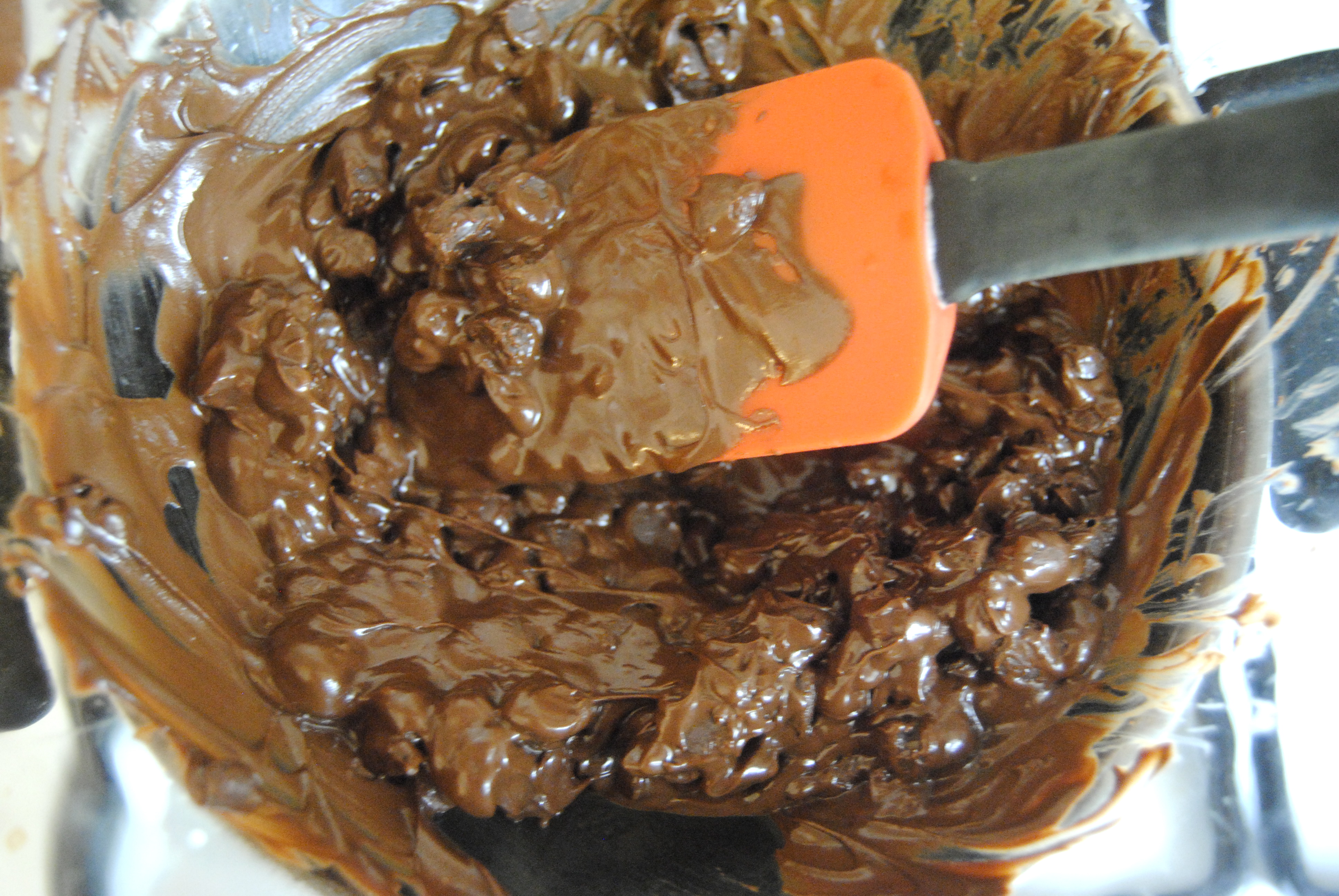
Let the cake cool for about 15 minutes, and while it’s cooling, melt the chocolate chips. If you have a microwave, then I’m jealous. If you don’t, create a double-boiler by boiling water in a small pot and placing a glass bowl on top filled with the chocolate chips. The heat from the water will melt the chocolate without burning it, and you just need to keep stirring every minute or so. Make sure the bowl that the chocolate will be in is at least an inch above the water.

Once that’s done, head over to your cake. Cut off that goldeny top and if any of the edges have browned, cut those off too. Eat them? I couldn’t resist… Now cut your cake into tiny squares.

Cover a plate with a thick layer of coconut. Dip all sides of your square into the chocolate, scrape the edges clean with the dull side of a knife, and then stand your square up in the coconut. Pour coconut on the top, drag it up from the plate and cover both sides. Grab the sides that are covered and roll the still-chocolate-covered sides into the coconut. Do the same for all the squares and lick yo’ fingas everrrrry time! Once finished, place the plate into the fridge to chill. Remove from the fridge at least an hour before serving so the squares won’t be stuck to the plate from the cold.

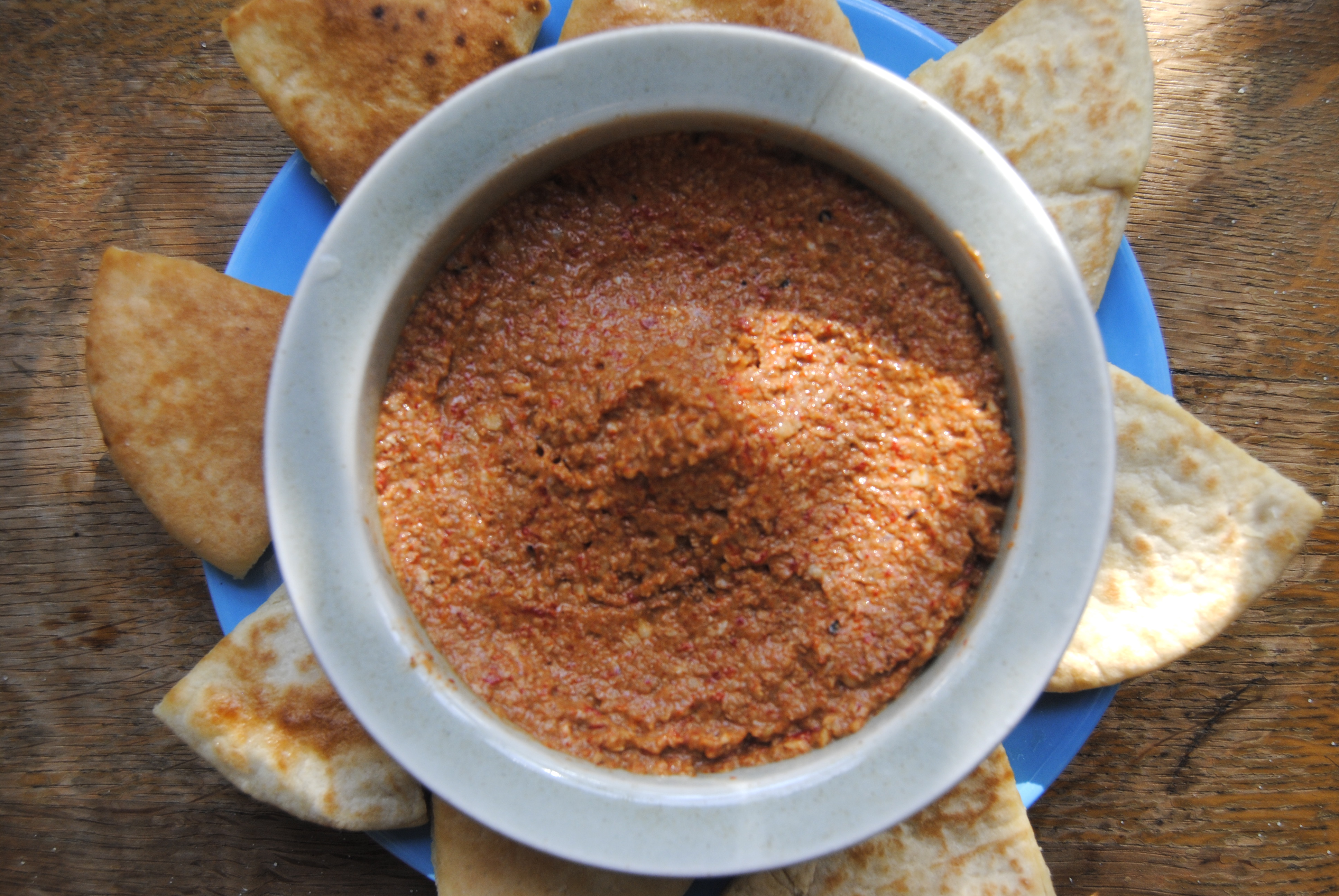
Muhammara (Moo-ha-ma-ra) comes from the Arabic word “reddened,” and is a sweet/spicy dip served on toast or with meat. I’ve read that it originated in either Syria or Lebanon, but at the risk of complicating things more, it really reminds me of my favorite Persian stew Khoresht Fesenjan (pomegranate walnut stew), which I’ll put up soon. Oh my god, how do I convince you HOW GOOD this really is? This is truly an incredible combination of flavors that dance all over your tongue with their sweet, spicy, tangy pazazz. This is a GREAT alternative to hummus, and, dare I say it, I think I like it even more. Although, I couldn’t really dip my way through an entire bowl like I could with hummus, but it was an incredible appetizer that would be amazing with meat in it. I didn’t have the “right” ingredients, so I adapted it from the authentic version just a little.

Where I found my inspiration

Serves: 3-6 (depending on how you serve it)

What you need:

4 pitas; cut into triangles

2 red bell peppers; roasted and chopped

1 slice of whole wheat bread; toasted and crumbled into pieces

1/2 c ground walnuts

1/2 c ground almonds

2 tblsp pomegranate syrup

2 tblsp olive oil

2 tsp lemon juice

2 garlic cloves; minced

2 pinches of cayenne pepper

salt & pepper to taste

How to do it:

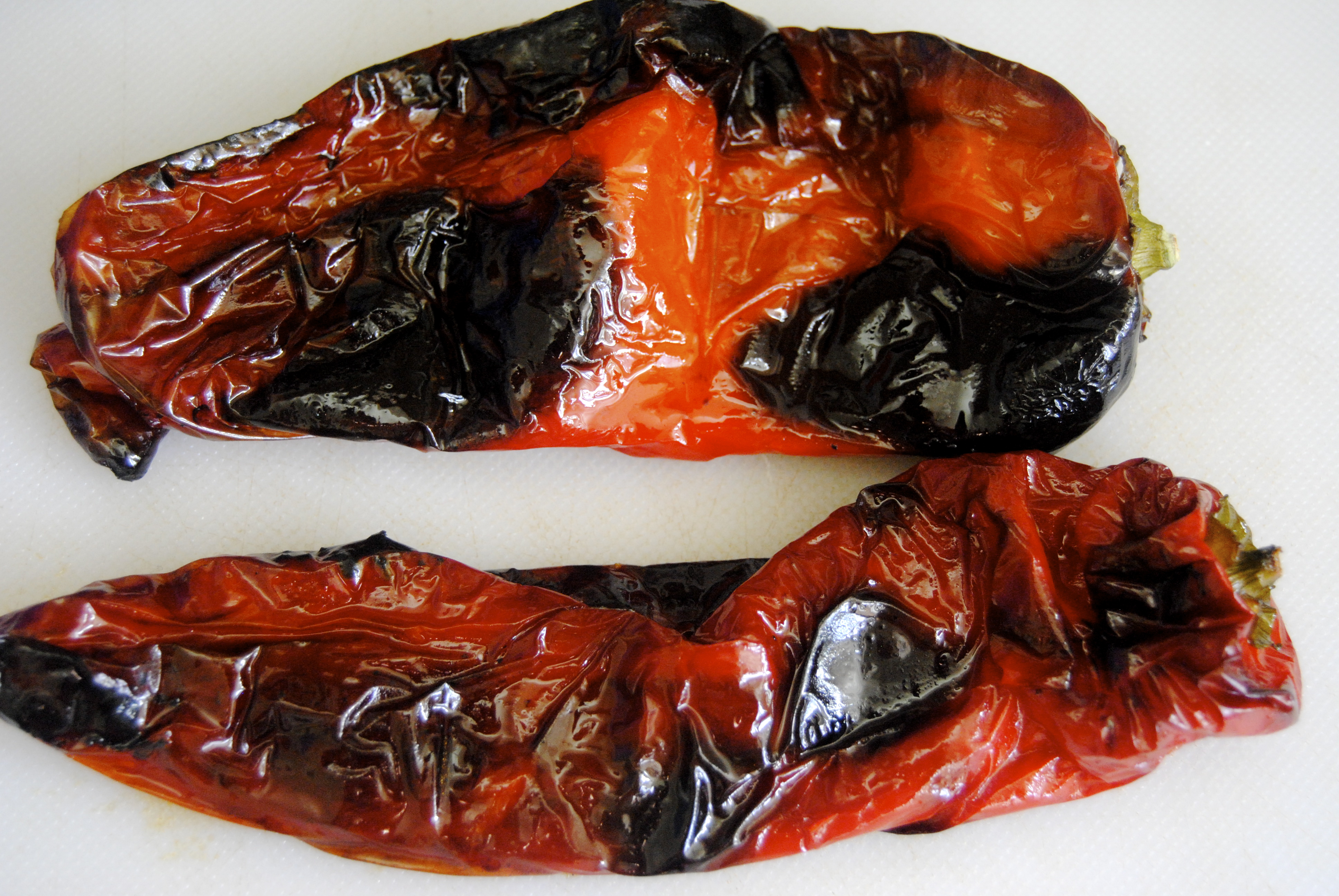
First roast the peppers this way (with no seasonings) or place them on a burner and char until fully black (I was in a rush and mine weren’t really black enough).

Put the bread, nuts, cayenne and garlic into a food processor or blender and blend until fine. Add the chopped roasted peppers, pomegranate syrup and puree until a smooth consistency (smoother than mine looks, but I didn’t have the right equipment). Add the olive oil, lemon and salt & pepper. Serve immediately or refrigerate for up to two days.

This would be amazing with ground meat added to it. Mmmm. Seriously, this is fantastic.

For the pita chips:

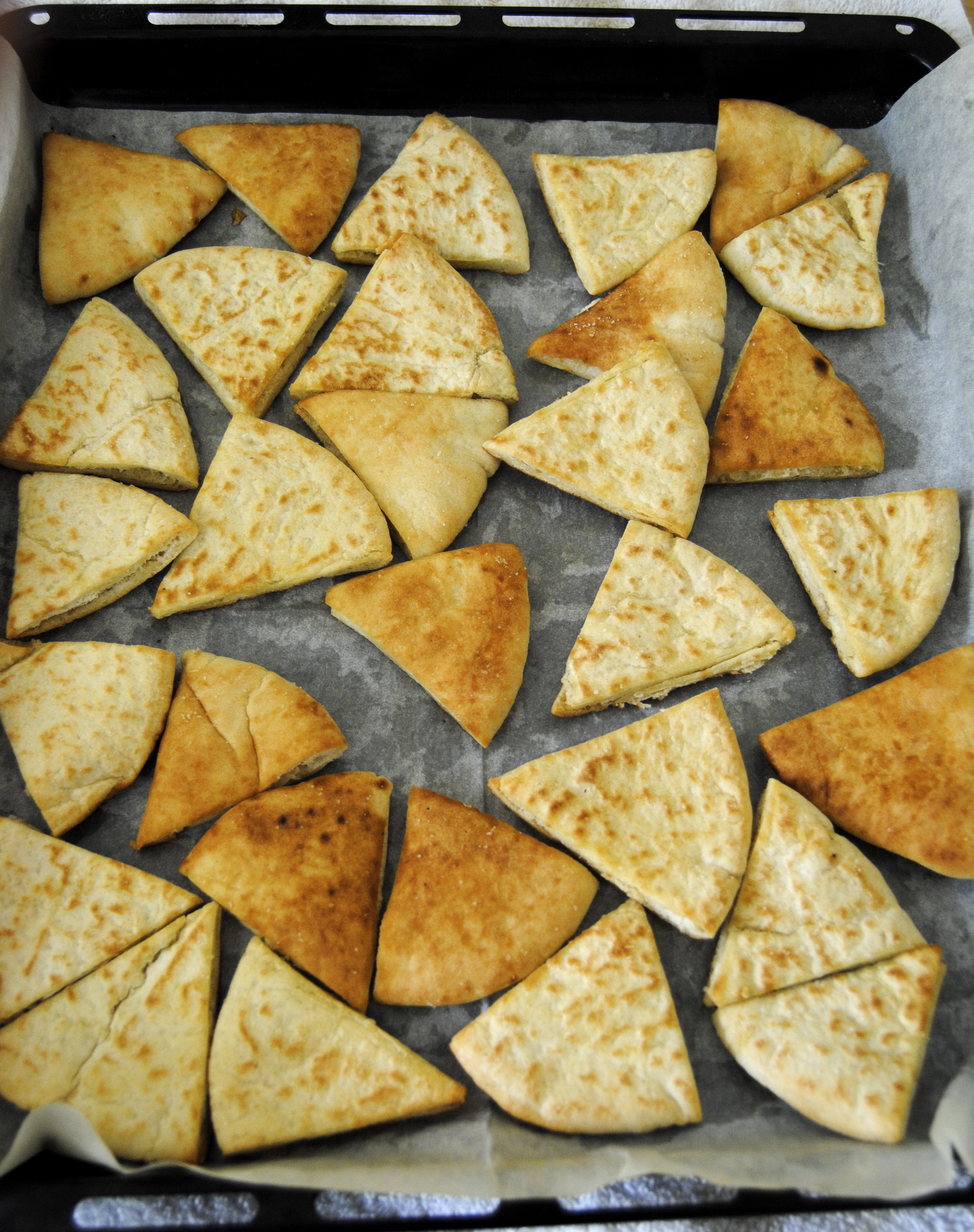
Grab your pitas, cut them into triangles, place in a bowl and toss with 1-2 tblsp of olive oil. Toss some salt on them and place them in an oven for about 8 minutes at 375 degrees.

Serve and enjoy!

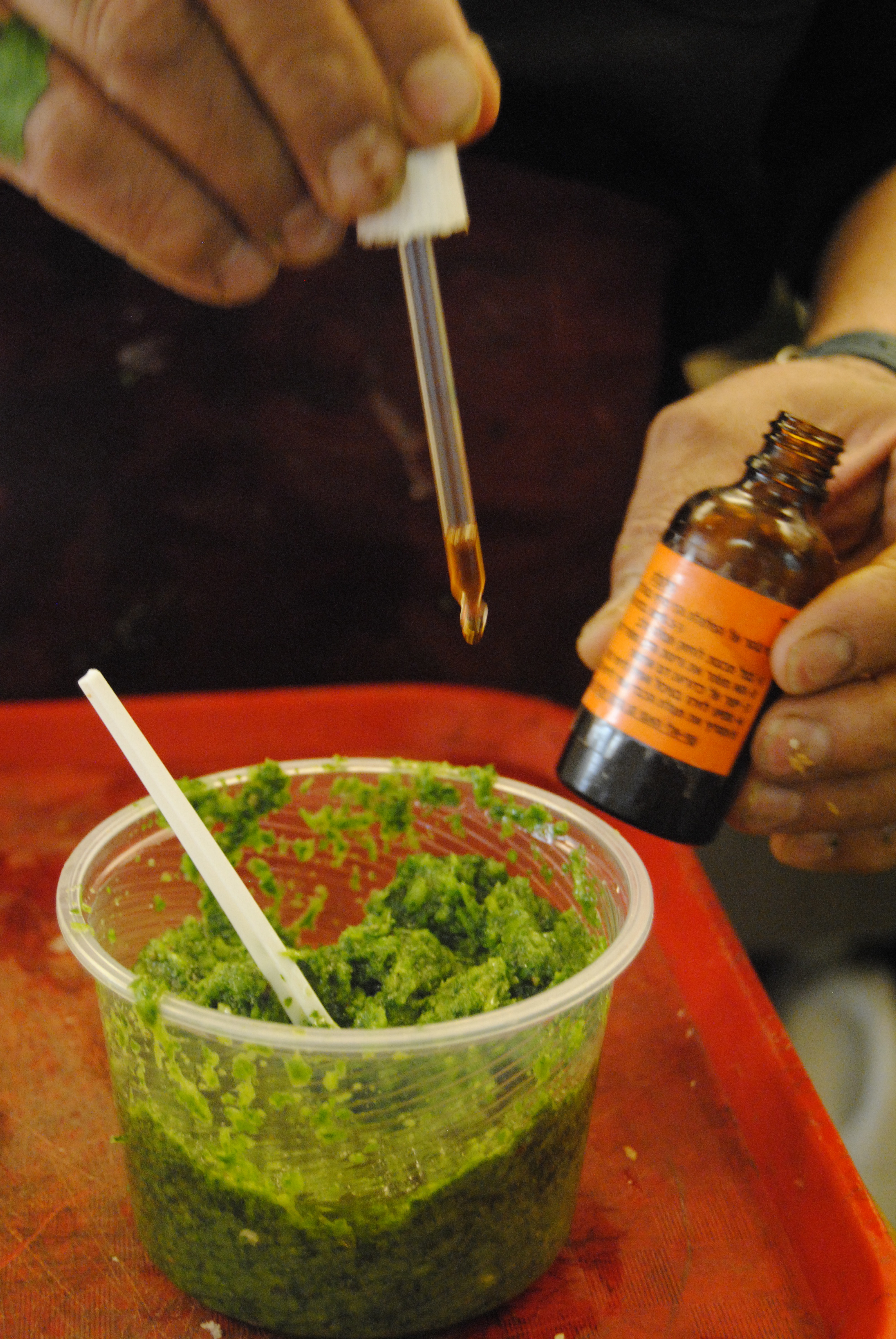
dropping a medicinal cayenne-spiked serum into the schug

I spent all morning today in one of my favorite places in the shuk, a small, ten-year-old shop filled with customers searching to heal ailments such as hypertension, migraines, sore throats and urinary problems. Once I heard someone ask how to heal her joint pain. His prescription: don’t be so judgmental, and then he also squirted two droplets of his famous ginger-camphor-mint-etrog serum into her palm and had her rub her aches with it. When you walk into his shop with a head cold though, he’ll quickly grab your finger, squirt some onto the tip, and tell you to stick it up your nose and inhale deeply. It usually makes me cry, but man, it seriously works. He calls himself the “Etrog Medicine Man” because etrog is a main ingredient in many of his recipes, and he also makes soaps, hand creams and sprays that offer dozens of medicinal etrog benefits. Etrog is a citrus fruit not quite orange and not quite lemon (though much closer to lemon). It can be as large as 6 inches in length, it has a bumpy exterior and is mainly used on the Jewish holiday Sukkot.

Uzi's shop from the outside. Need directions there in Jerusalem? From the Agripas side, enter the outdoor part of the shuk. Take your first right through the stall and walk until the end. There he is!

From the wisdom of his grandfather, passed onto his father, passed down to him at 11 years old, Uzi Ellie’s medicinal drinks ease ailments as benign as the onset of a cold to something more sever, such as ulcers and diseases. Just this morning he encouraged me to gargle with a gingko biloba-cardamon-ginseng-honey-qat mixture and to drink more water to manage my migraines. It burned and tasted awful until the qat set in and my mouth began to tingle. I felt pretty good.

On this particular morning, however, Uzi Ellie taught me how to make Yemenite Schug (a spicy dip that goes on meat, hummus or in soup and pronounced: Skh-ooo-g) and a Passionfruit, Goat’s Yogurt drink. He blessed me, showed me how he blesses the food that he shares with his customers, let me join into the food-making process, taught me the medicinal value of some of his most popular items, got me a little high from the migraine/qat serum, had my soul assessed (I’m doing great, in case you’re wondering), and, most importantly, gave me an experience I will never forget. If you are ever in Jerusalem, I really encourage you to stop by his shop. He is well known in the Machane Yehuda Market (the “shuk”), and his shop really does boast dozens of health benefits, interesting flavors, and an unforgettable experience for anyone.

Making the schug together:

This plant is a garlic & green onion fusion. It doesn't grow in Jerusalem and Uzi Ellie gets it from a farm outside the city. We used about 30 bunches.

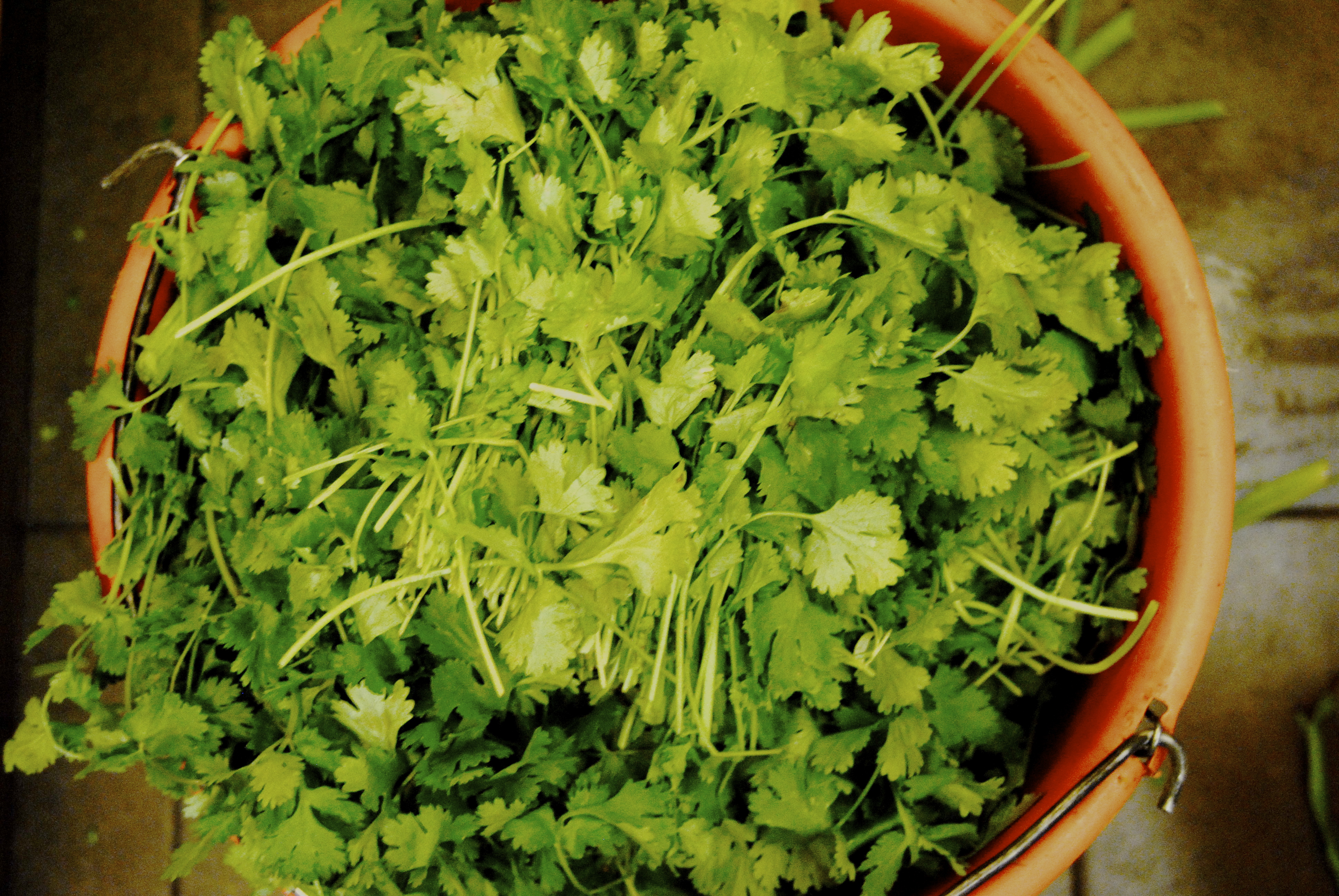
About 25 bunches of fresh cilantro

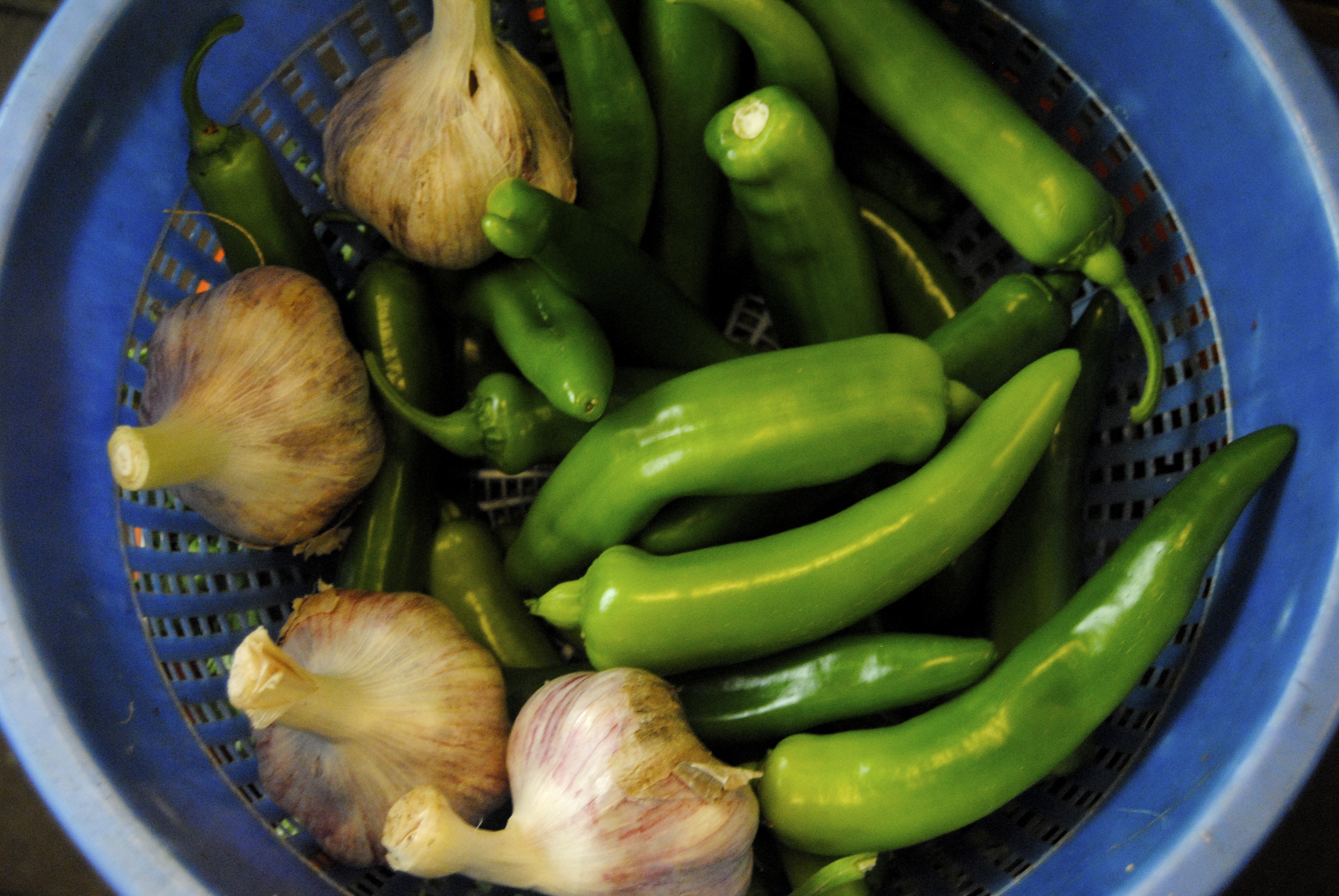
1 kilo of spicy green peppers and 1/2 kilo of garlic

All the garlic (including skin) goes into a blender with 3 C water

Garlic and water mixture are placed into a sieve, the thick chunks discarded

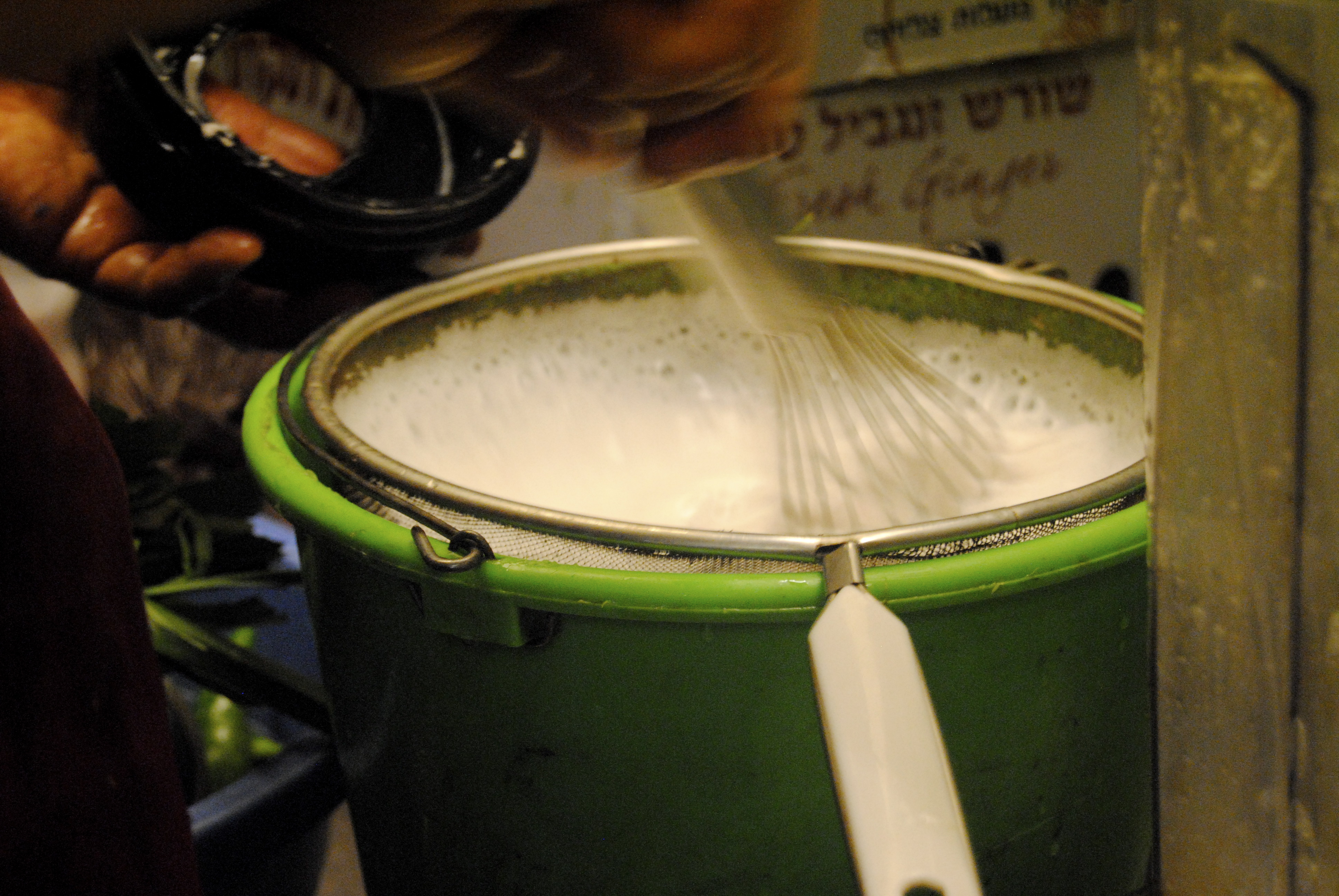
green onion/garlic plant and cilantro go into the blender with the strained garlic juice, then they are strained in the sieve with the garlic (they blend together here) and the juice retained

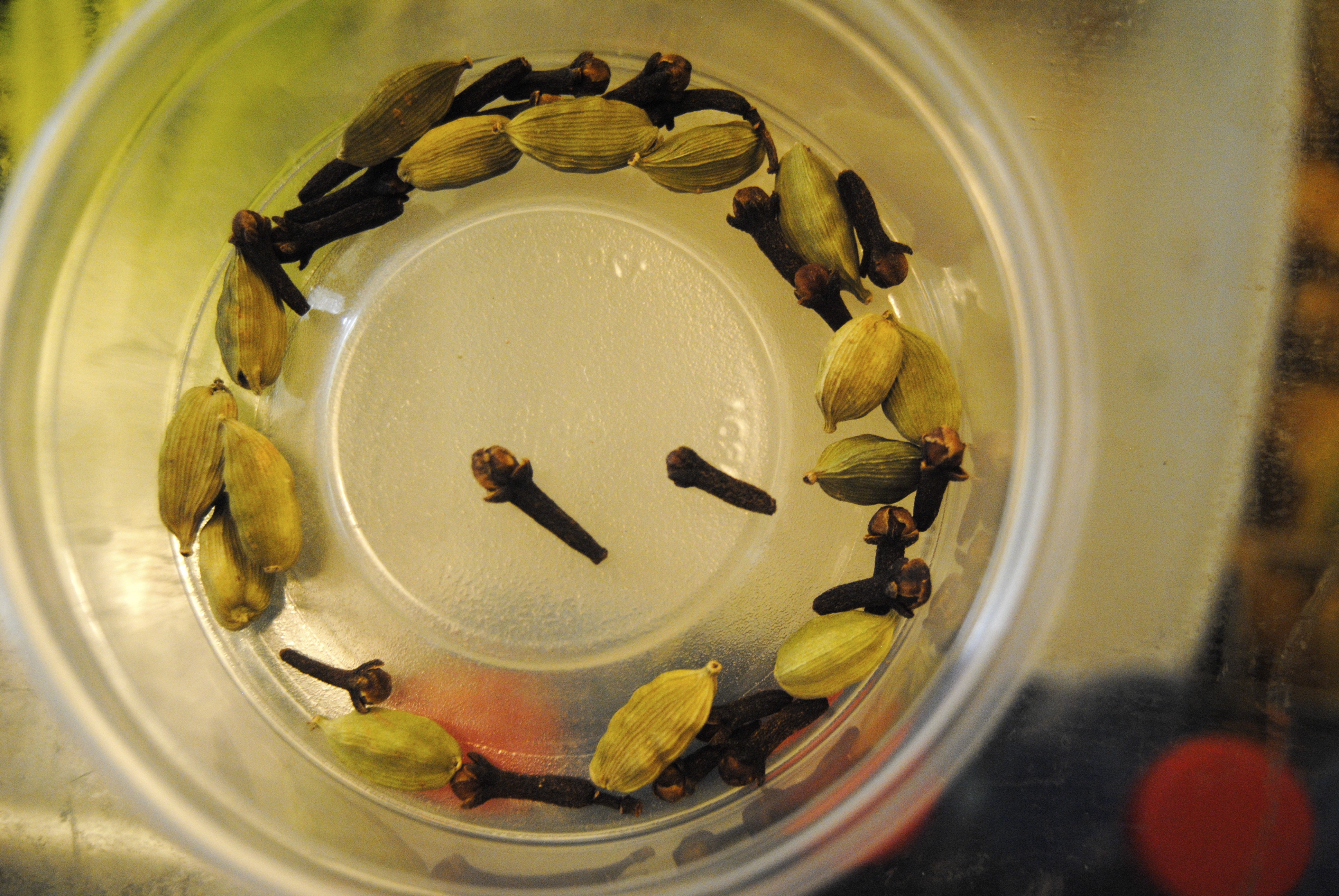
whisk the blended greens around till they form a thicker consistency. the mixture (which is now the greens with the garlic) goes back into the blender and kosher salt, a drizzle of olive oil, cloves and cardamon pods are added and blended.

To make schug at home, for under a million people, Uzi Ellie also gave me this recipe:

2 bunches of cilantro

2 hot green peppers

1/2 head of garlic

1/2 tsp kosher salt

drizzle of olive oil

1 bunch of green onion

11 cloves

5 cardamon pods

Put everything into a blender with 1/2 cup of water.

Passionfruit, Goat’s Milk Drink

giving the drink a blessing so that it may heal his customers

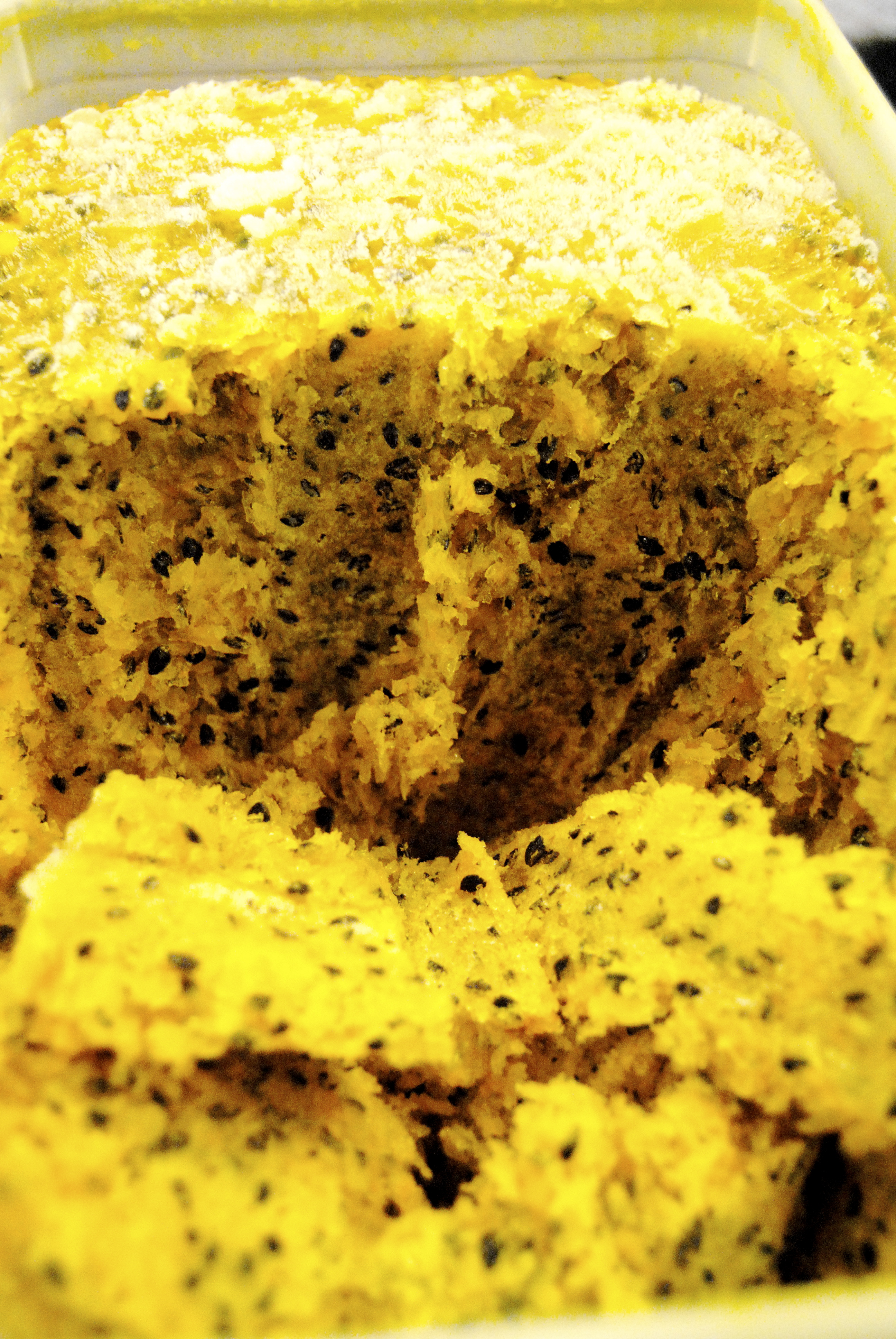
he takes fresh passionfruit and freezes it. then he places it in a machine that separates the seeds from the juice. then he puts the juice into a blender.

here comes the milk....all dressed in white...and some sugar, too

then everything is blended with the world's largest immersion blender

He didn’t give me any special tips on this, but to make a couple of drinks’ worth, I would guess you would need something like:

10 oz goat’s milk (you could use your favorite yogurt instead)

10-13 passionfruit with the insides scooped out

2-3 tblsp sugar

that's Uzi on the left

his various serums, treatments and sauces

Where to begin when we’re talking about challah bread? I have never met anyone who doesn’t like challah bread. It’s good for breakfast as french toast, I use leftovers as sandwich bread for lunch, it soaks up all the juices of Shakshuka like they were made for each other, and it makes a great dessert in bread pudding. The trouble is finding a recipe that actually works, finding one that’s easy to follow, and knowing a few tricks from people who have made it over and over.

When I first started making challah bread, I made a lot that were as dense as brick, in fact, I considered carrying it with me when I had to walk alone at night instead of Mase. I ended up wasting a lot of groceries and an incomprehensible amount of time. This recipe, on the other hand, comes straight from a religious woman in Mea Shearim, one of the oldest neighborhoods and most religious neighborhoods here in Jerusalem. The ingredients are simple and low in quantity, so if you mess up, you won’t have to run to the store again to buy more sugar. It’s subtly sweet, doesn’t taste too eggy, is soft and pulls apart like cotton candy. Sometimes I add dates, olives & zaatar, and when I make it for the kids I babysit, I always add chocolate chips.

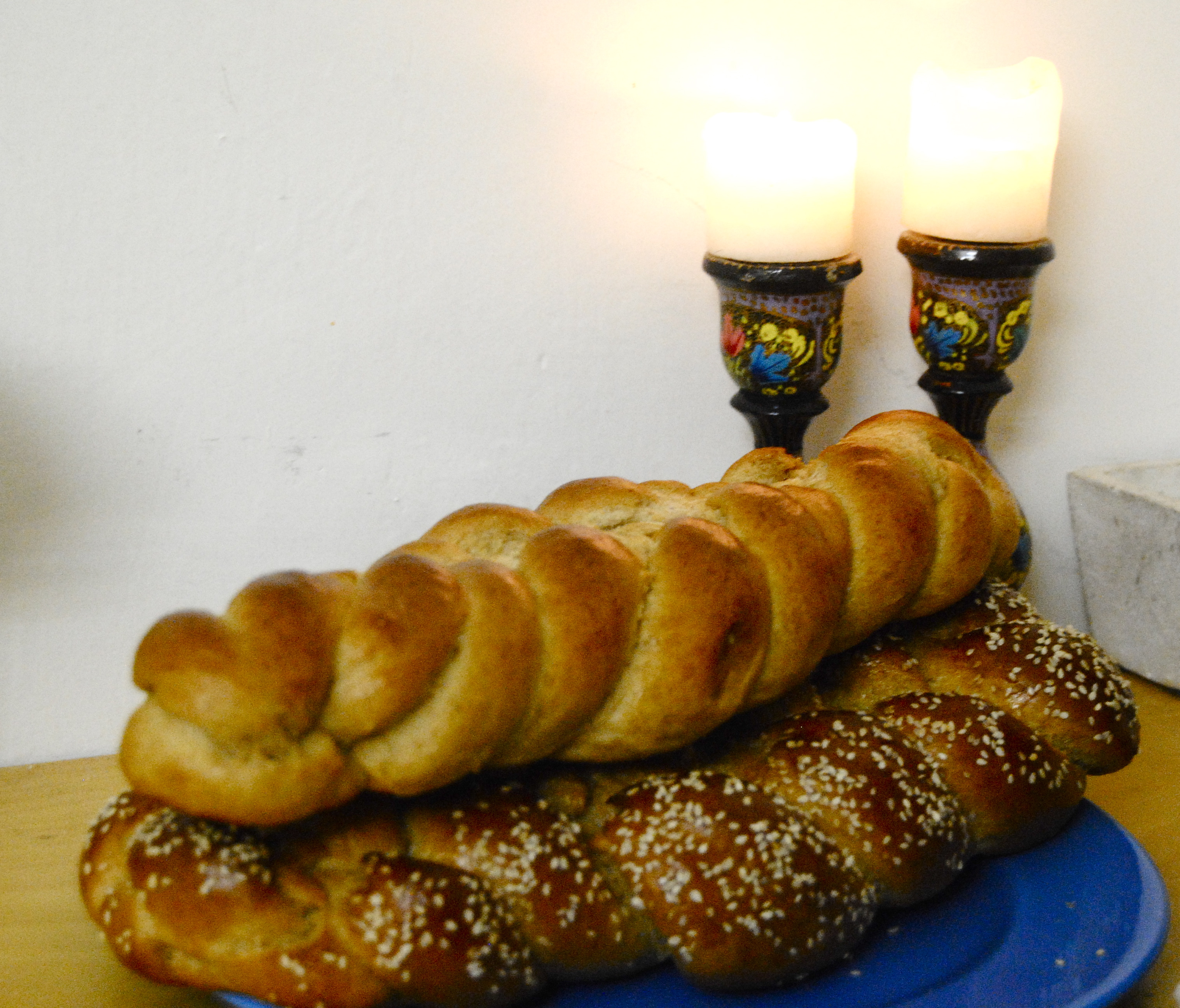
Today, challah, for all its uses, is mainly eaten at Shabbat meals and on holidays and is thought of as that golden, shiny braided loaf. But it actually refers to the small piece of the bread that is blessed, separated from the dough and burned for a blessing, or in ancient times, was set aside for the priests as an offering to God. To learn how to make this blessing, click here.

Makes 3 medium challahs or two large challas

Note** This recipe may look overwhelming because of all the “steps,” but it only looks that way so as to eliminate any confusion. This is a very simple recipe and the photos are just to illustrate steps. Don’t be scared!

What you need:

The real recipe calls for: 2 cups whole wheat four, 2 cups of spelt flour and 2 cups of white flour, but I rarely do the spelt because it is expensive here. I made it with spelt in the beginning of my challah journey, and it was delicious, but without is also a hit! And you’ll still get all the oooos and ahhhs because it’s whole wheat.

Bowl One:

1 tblsp active/instant yeast

1/2 c white cane sugar

2 c of warm water, 1 c for the yeast mixture and one for the egg mixture (should be baby bottle temperature, or if you have no experience with that, you should be able to hold your finger in it for five seconds without screaming)

Bowl Two:

1 tsp salt

3/4 c vegetable oil (plus another tblsp for later when the challah rises)

1 egg (plus one more for later for the egg wash)

And then we’ll add the following after we combine bowls one and two:

3 1/4-3 1/2 c all-purpose flour

3 1/4-3 1/2 c whole wheat bread flour

2 1/2-3 hours! (though it will be rising for most of this so you can continue on with your life)

The last ingredient is to “cry into the dough.” I’d say this is “optional.” I can’t cry on command.

Just some tips so you don’t have to fail as many times as I did:

1. If you want to play with this recipe and sub things in it and out, less oil, different sugar, you can but you should be cautious. You can use agave nectar or regular honey in place of the sugar, and you can reduce the oil to 1/2 c, but don’t play with the salt or the eggs.

2. While you’re braiding the challah, don’t talk to anyone or watch tv at the same time. You will get distracted, forget what you’re doing and end up with a misshapen challah bread.

3. You will need to make challah a few times before really getting a sense of when the dough is ready. There are “tests” you can do to check the dough, but the truth is, it’s just something that you will begin to “feel” as you make them a few times.

4. If your challah is feeling really sticky after it rises, lightly flour your surface or put it in the fridge for 20-30 minutes and let is rise for another 15 when you take it out.

5. If you fail this time, be patient. This is a simple recipe, but it takes time and some arm strength. But I’ll try to explain as best I can so that you won’t have to heed this message.

Let’s Begin:

Pour your yeast and sugar into a soup-sized bowl (glass is best if you want to watch all the action happen). Mix the two together so they are well combined and add the water. If the water is scalding, the yeast will not rise, so make sure it’s the same temperature you would feed to a baby or that you can keep your finger in it for about five seconds without burning yourself. After you’ve added the water, give the mixture a stir and let it sit, unmoved, for about 10 minutes to “proof.” If nothing happens after this time, start over. The yeast was dead. This is what it should look like after two, five and ten minutes. While the yeast is rising, prepare bowl two (should be a large bowl that you will mix the dough in).
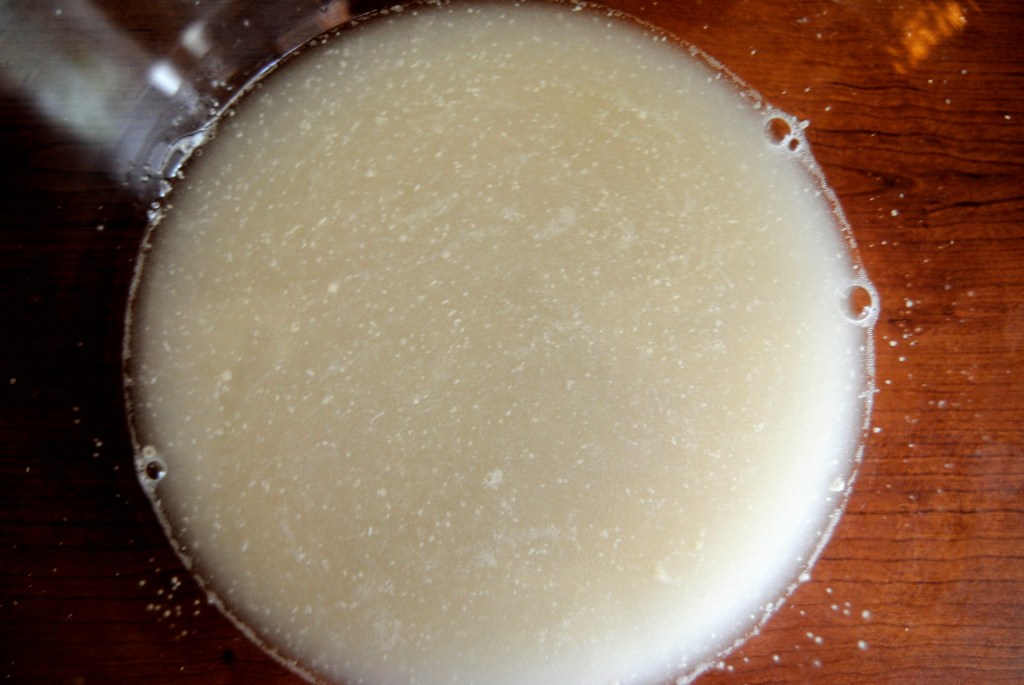
After two minutes
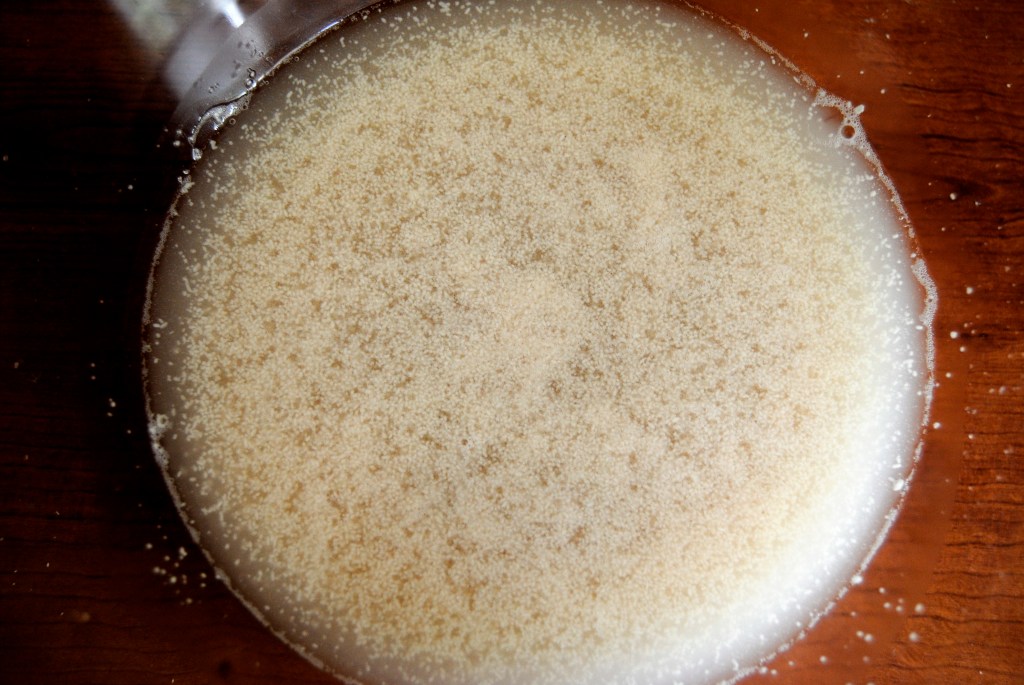
After five minutes
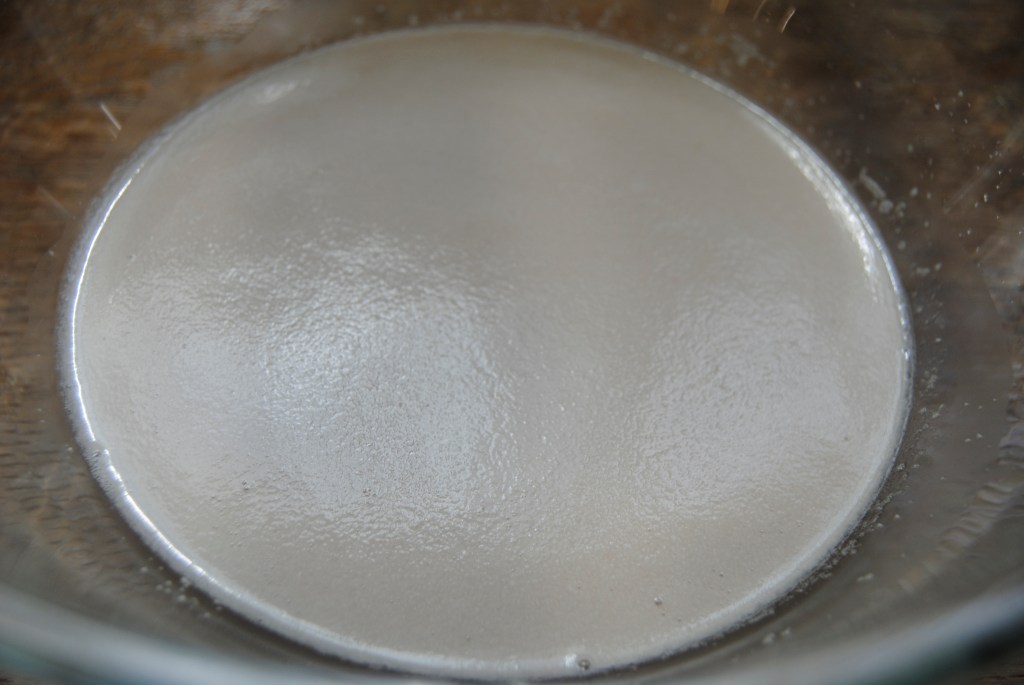
After ten minutes (it should begin to kind of resemble cellulite)

The main thing you are looking for with the yeast is that it has become foamy. Combine bowls one and two and give a good few stirs.

For those of us without a Kitchen Aid, here’s what you do. Add five cups of flour to the mixture without stirring (half whole wheat, half all-purpose). It will still be a sticky, shaggy ball. 

Add one more cup of flour and combine it so that you are spreading the dough apart but more trying to cover the dough with the flour and create a dry surface (this is so you can handle the dough).

Lightly flour a work surface and place your dough onto it. Familiarize yourself with this technique for kneading before you begin.
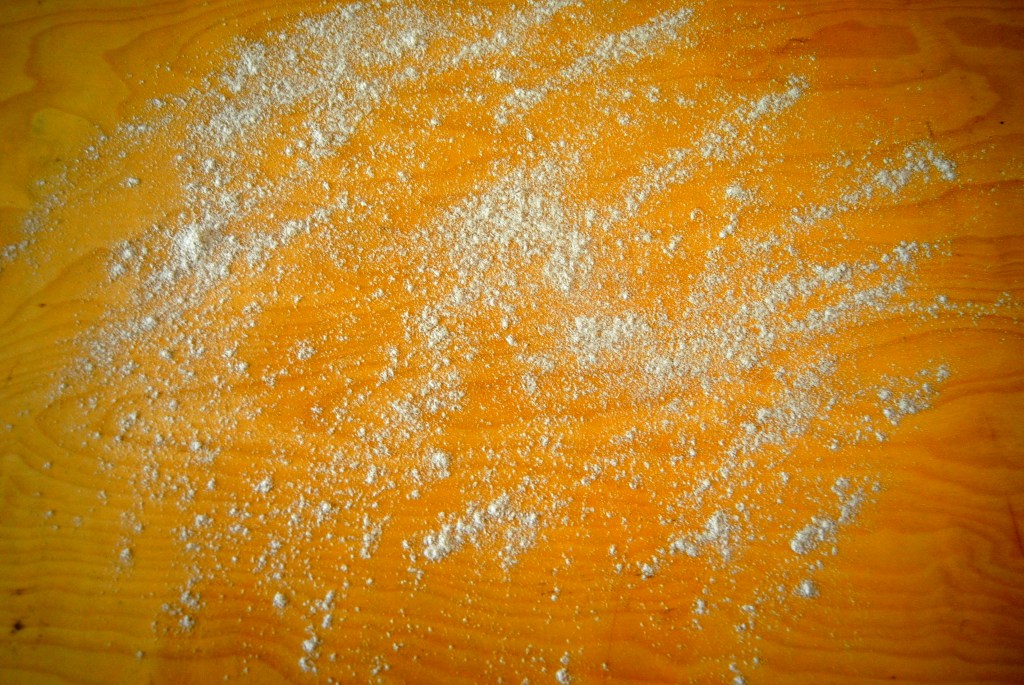
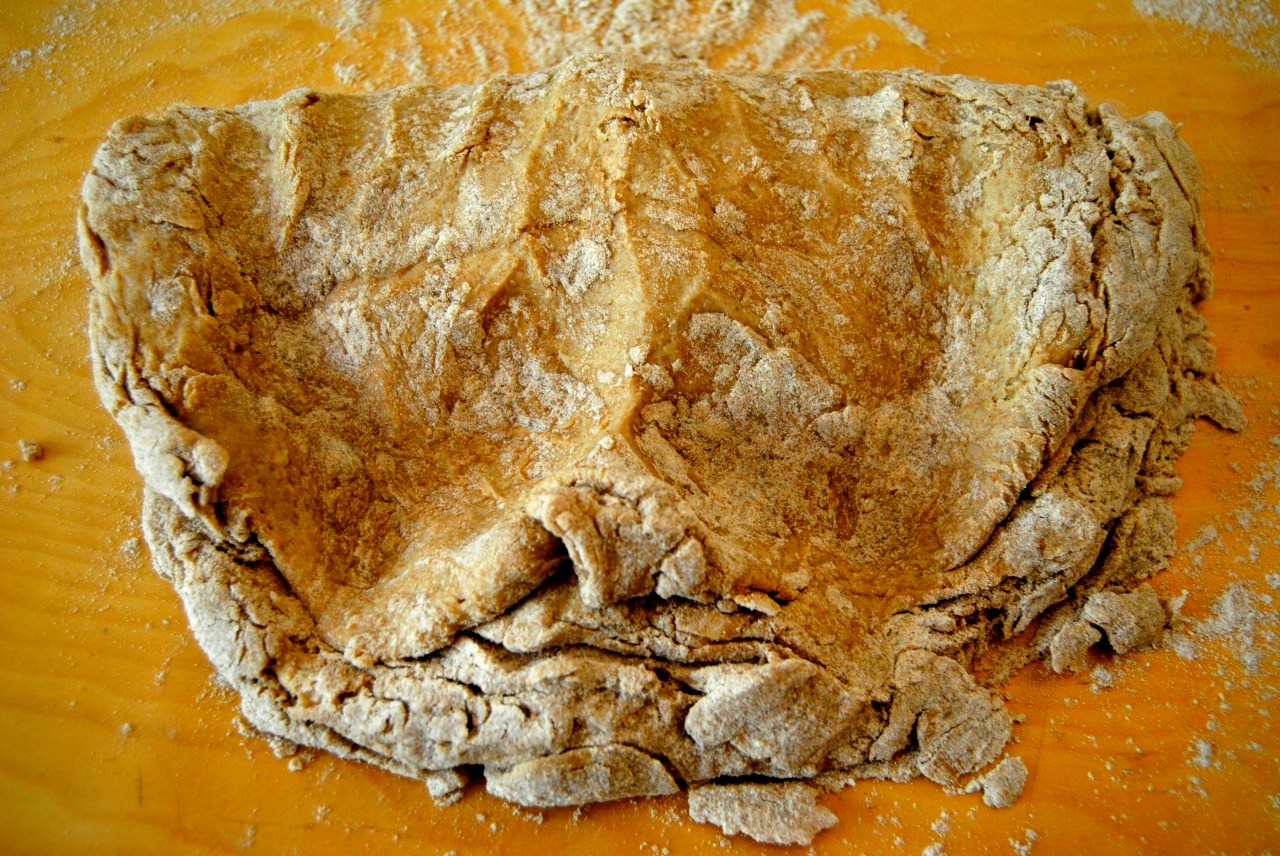
Now you’re going to knead your dough for 10-15 minutes. The technique for knead the dough is once  you place your dough onto the floured work surface, tuck all the loose pieces and edges in so you have a circular, clean shape.

Then you’re going to take the top and fold in down to the bottom.

When you fold it down, press the heals of your palms into the bottom of the dough.
Turn the dough 90 degrees to the right and start over again, folding, pressing, turning.
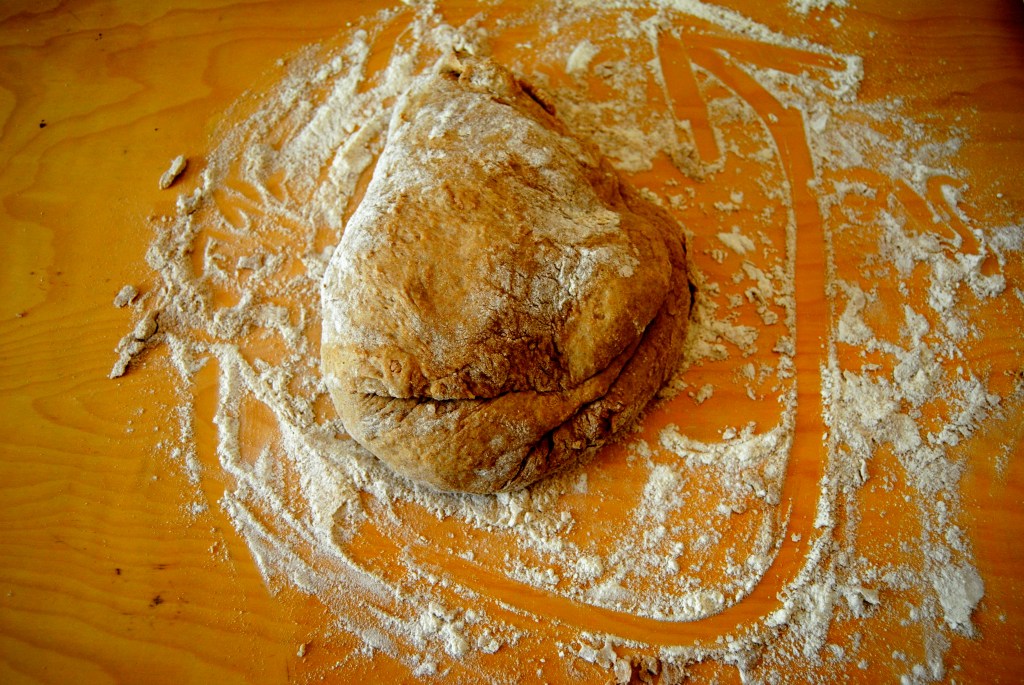
As I said, now fold the top down to the bottom and repeat. You’ll get faster at doing this. But that’s how you should be kneading the dough for the next ten minutes. As you knead, do not dig your fingers into the dough. You want the dough to stop feeling sticky, so turn it gently, fold & press into the dough with force, but don’t spread it outward.

Once your dough no longer feels sticky and feels somewhat light and elastic, push your finger into it. If the mark remains, your dough is ready. If it springs back fast, knead your dough a few minutes longer.

Once your dough is ready, smooth and elastic feeling, place it on the counter and go clean out the bowl you mixed everything in. Wipe it down, add a tblsp on vegetable oil and place your dough into the bowl. Spin it around, flip it over, spin it around and make sure the dough is covered with the oil. If you need to, add a little more oil. Place the bowl inside a large plastic bag (or cover with a damp town, but I think the bag is fun), and let is rise in a warm place for 1-2 hrs OR until the dough has doubled in size. It’s usually somewhere in between.

Once the dough has doubled, place it back onto a surface (it doesn’t need to be floured). The dough will feel AMAZING. Seriously. Spread the dough out into a long rectangular shape and press out all of the air bubbles. How good does that feel?!

If you’re making three challahs, with a knife, divide the challah evenly into three chunks. If you’re making two, divide it evenly in half. For instructions’ sake, I’m going to pretend as if we’re making two large challahs. Take one of the chunks, loosely ball it back up and place it back into the bowl. Divide the other half into two equal pieces, and then each of those pieces into two equal pieces so that you have for squares.
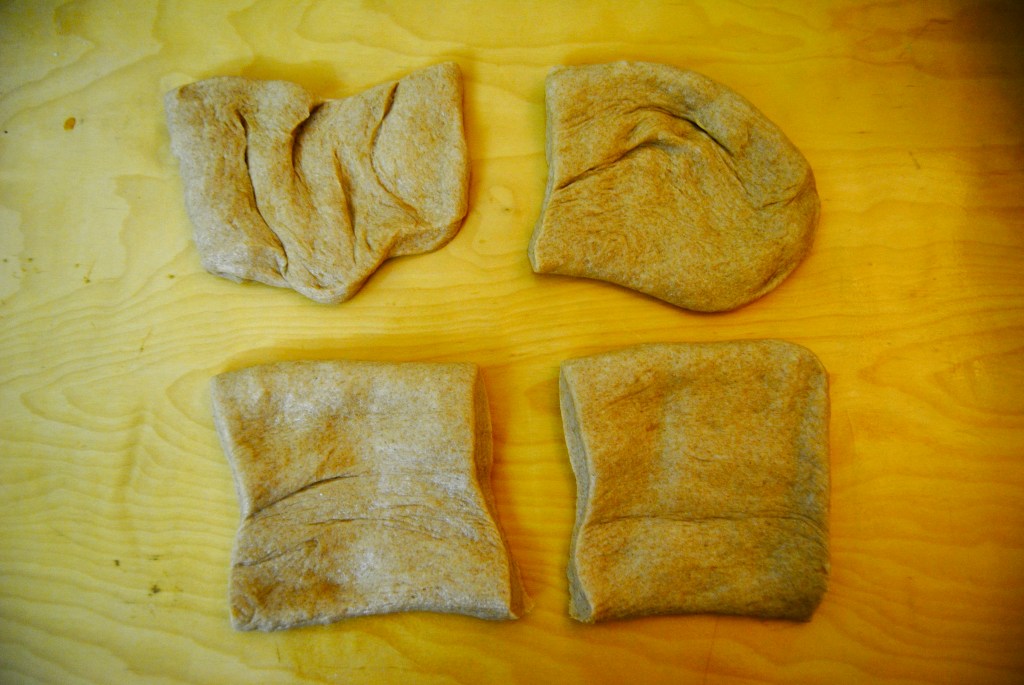
Loosely ball them up and place three to the side. Take one, and flatten it out with a rolling pin or with a cup and take the top and roll it over like you’re making a long snake. If you want to add dates, raisins or olives, add them at this stage by placing the dried fruit in the middle of the flat portion and eventually rolling over it, combining it, as you make your strands.

Press your fingers down and seal the roll into the flattened part of the dough. Continue like this until you have a roll.
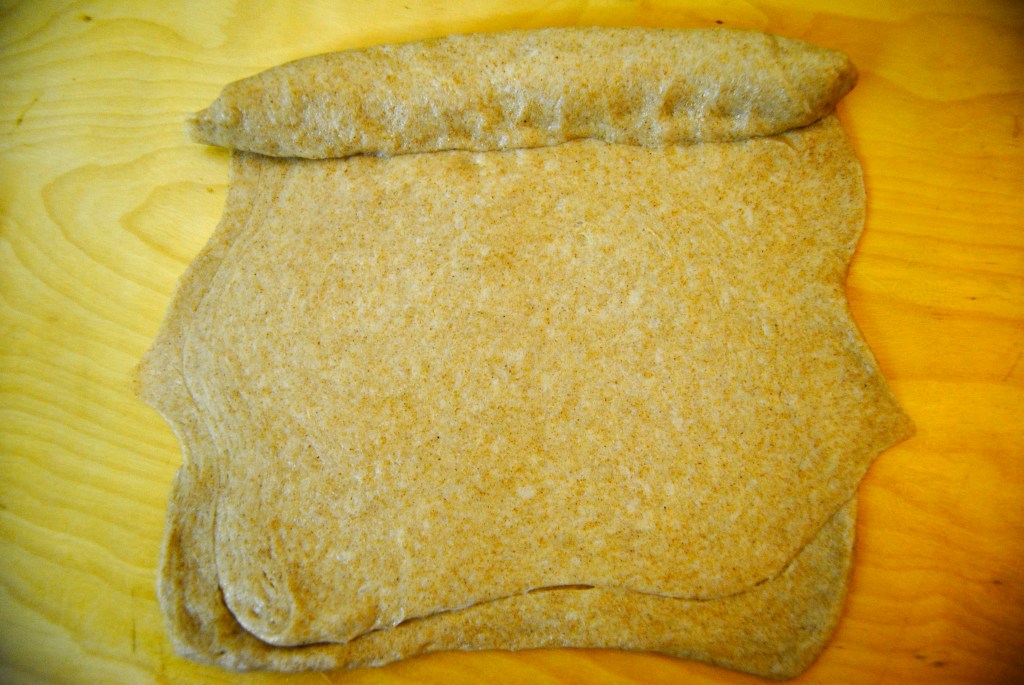
You’re doing this so the strands are clean and braid nicely. Now, the roll with have a visible seam. Roll it out until the seam disappears or is close to disappearing. Place your hands flat on the roll, fingers tips inward and heals of your palms slightly outward. Roll out the strand like this because we want the middle to be thicker than the ends.

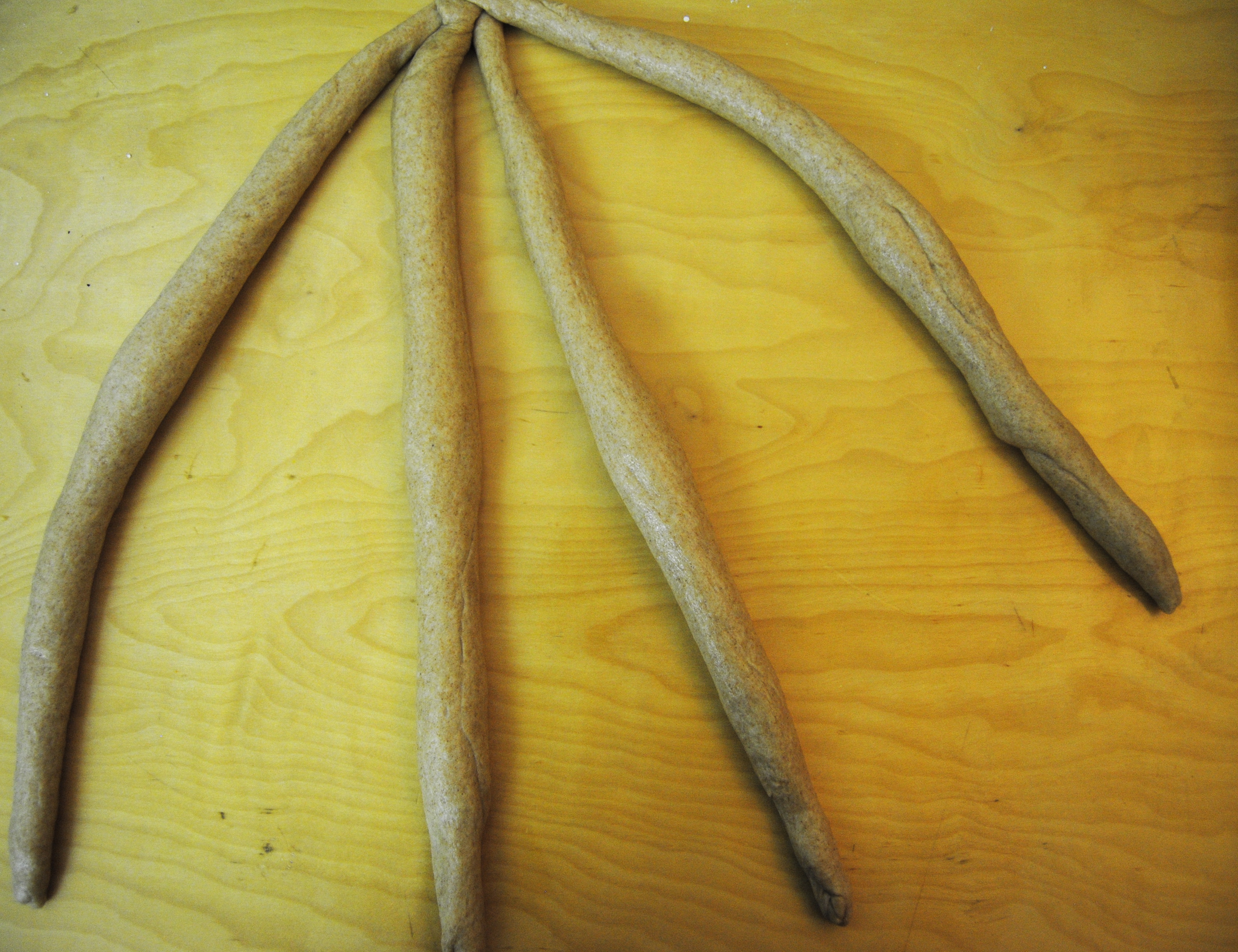
Once you have done this to all four strands, place them side by side, roll the ends a little skinnier, and pinch them off (loosely) at the top.

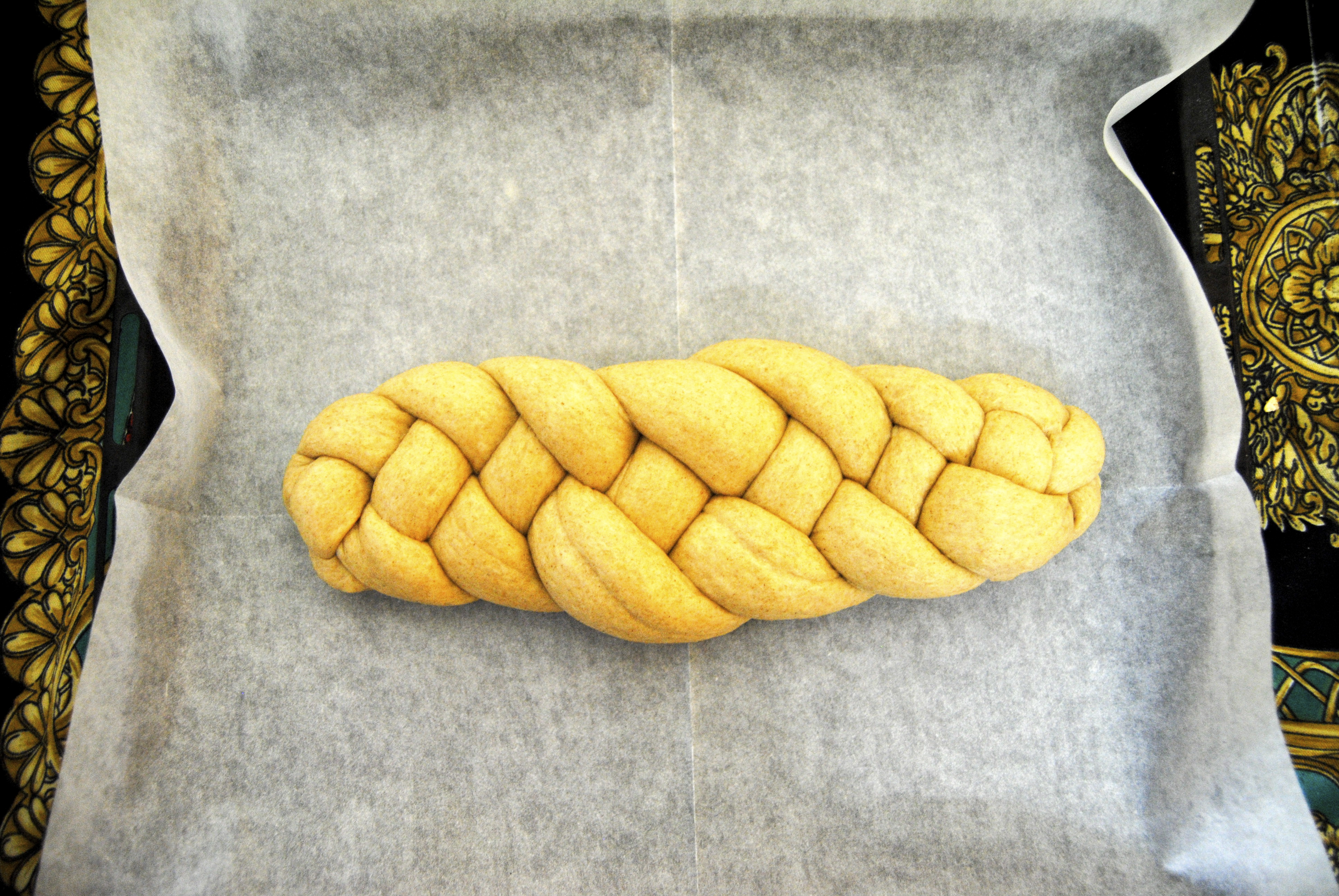
To do a four-strand braid, you can do this two ways. I’ll show you both. Based on the above picture, let’s call the left most strand #1 and the right most strand #4. The plan: over, under, over. Take #4 and carry it over #3, under #2 and over #1. Now strand #3 has taken the place of #4 (meaning it is now the right most strand). Take the “new” #4 and carry it over #3, under #2 and over #1, just as you did before. Do this until the braid is completed. Now pinch the ends together, twist them and tuck them underneath the braid to make it look clean and round. You can now until the top portion that you loosely pinched together and rearrange them tighter, pinch together (pictured below), twist and tuck underneath the top portion of the braid.

OR

The plan: under 2 backward one, switching from the right most strand to the left most strand. Following the same model above, from the right side take #4 and carry it under #3 and under #2 and then wrap it back over #2 so that it rests between #2 and #3. From the left side take #1, go under #2, under #4 and back over #4. Repeat this pattern until you run out of strand, pinch the ends together, twist and tuck underneath. This is the pattern for a 6-strand braid, but I like the way it makes four-strands look.

Four-strand braided the first way

Four-strand braided the first way

Four-strand braided the second way (sorry about the picture quality!)

Put the challah immediately onto parchment paper on a tray, don’t handle it too much, and let it rise for 25 minutes. If you want an extra-dark challah, brush it with egg yolk now and then you’ll do it one more time before it goes in the oven. Preheat your oven to 350 degrees now. And after they rise, bake for 30-35 minutes. At 25 minutes check your challah though since all ovens are different. You’ll know it’s ready when you lightly tap on the strands and on the base and you hear a thump thump sound. Let cool and cover until ready to serve.

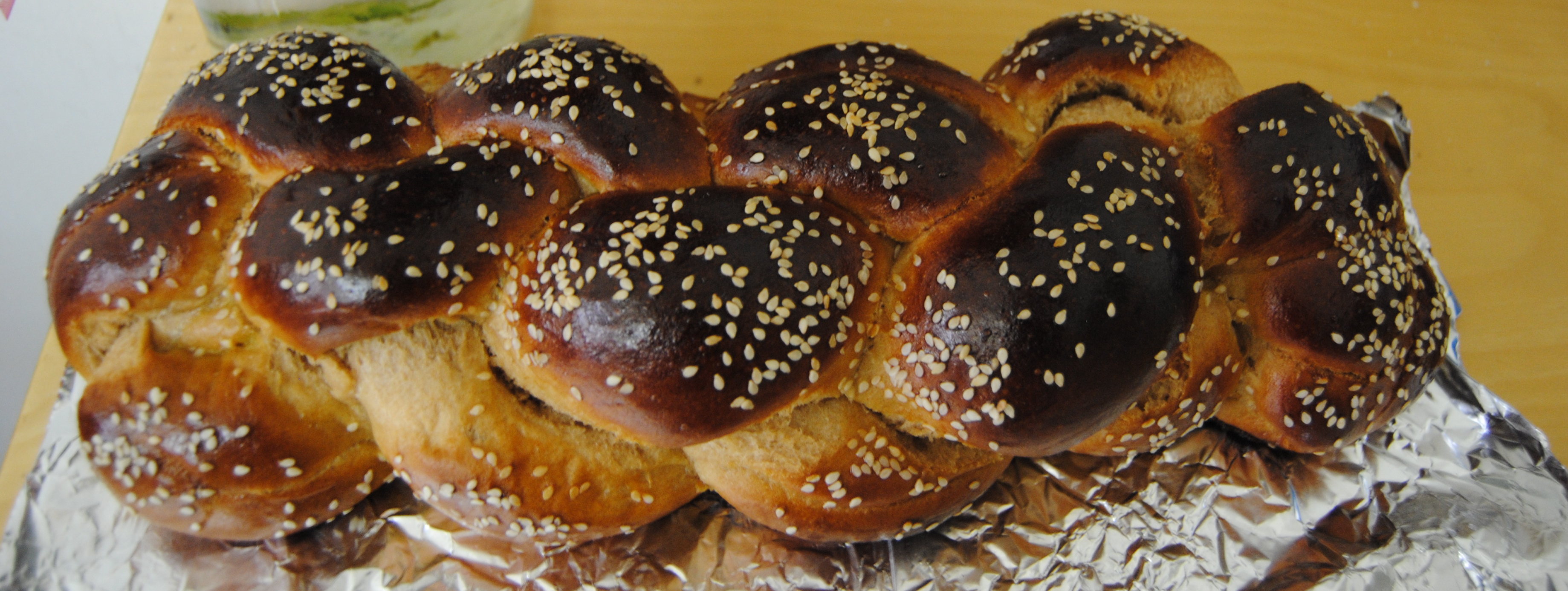
Four-strand braided the second way and I did two coats of egg wash to make it darker

You can also do lighter-colored challas with just one coat of egg wash. If you are only doing one wash, do it right before the challah goes into the oven and you can add sesame seeds or poppy seeds at this point. The lighter ones look like this:

dsc0100_2

You feel that in your mouth? Those are your salivary glands screaming, “Feed me!” Wow, this was insanely delicious, especially after I gave up trying to keep it “healthy” and just doused it with a second round of syrup. For Baklava, either indulge, or don’t even bother. This recipe worked amazingly, but you can substitute any nut for the ones I’ve listed if you want to. Also, you can do more than one layer of nuts, though I only did one, and if you decide to, you’ll need to increase the measurements below. All of the portions for the nuts are after they’ve been chopped.

What you need:

1 pkg of phyllo dough (if you’re in Israel, this is not puff pastry) **I used one pkg, but if I made it again, I would buy two pkgs. Bottom line, you want about 22 sheets and the packages in Israel are only 15)

1 1/4 cup of unsalted butter; clarified  (click HERE to learn how to do this. don’t ditch the recipe because this seems scary!)

about 1/2 cup pistachios; chopped coarsley

about 1/2 cup walnuts; chopped coarsley

about 1/2 cup almonds; chopped coarsley

1 tsp ground cloves

1 tsp ground cardamon

1 tsp ground cinnamon

Incidentally, you’re also going to need a cooking brush or a baster, a baking tray, a damp towel and a knife.

For the Syrup:

2 cups of sugar

1 cup of water

1 tsp of fresh lemon juice

1 tsp each of rose water and orange blossom water (I didn’t have orange blossom, so I did a little more rose water) *this is also optional, since I know that for a lot of people eating rose water feels like eating perfume, or your grandma.

How to do it:

Believe it or not, this will take under 15 minutes!

Preheat your oven to 350 F. Grab a dishtowel, wet it completely, wring out well and set aside. This is for the phyllo dough which will need to be covered since it dries out quickly. No biggie. If your clarified butter was refrigerated, warm it up. We need it! Before getting started, go get everything and make sure it’s all nearby. And because the phyllo dough is so tempermental, familiarize yourself with what we’re going to do so you don’t need to constantly check back and forth: 10:2:10. Ten sheets on the bottom, two in the middle and ten on the top layer of the baklava. After ever two sheets, you need to butter the phyllo dough with your baster/brush.

Combine your nuts and pour 4 tblsp of the clarified butter over them. Combine well.

Butter the bottom of a 9×13 inch baking tray well with your baster/brush. Roll out your phyllo dough carefully and place it flat. If some of it is torn, don’t worry, okay? Make sure you have 22 sheets. If you forgot that detail at the store, just make sure you have an even ratio on the bottom and top and a multiple of two sheets in the middle. If numbers stress you out, just try and make it work. If your sheets are big, cut them in half (or so they fit easily into your tray without too much “muffin top” happening). You want about 1/4 inch hanging over, which we will use as filler later on.

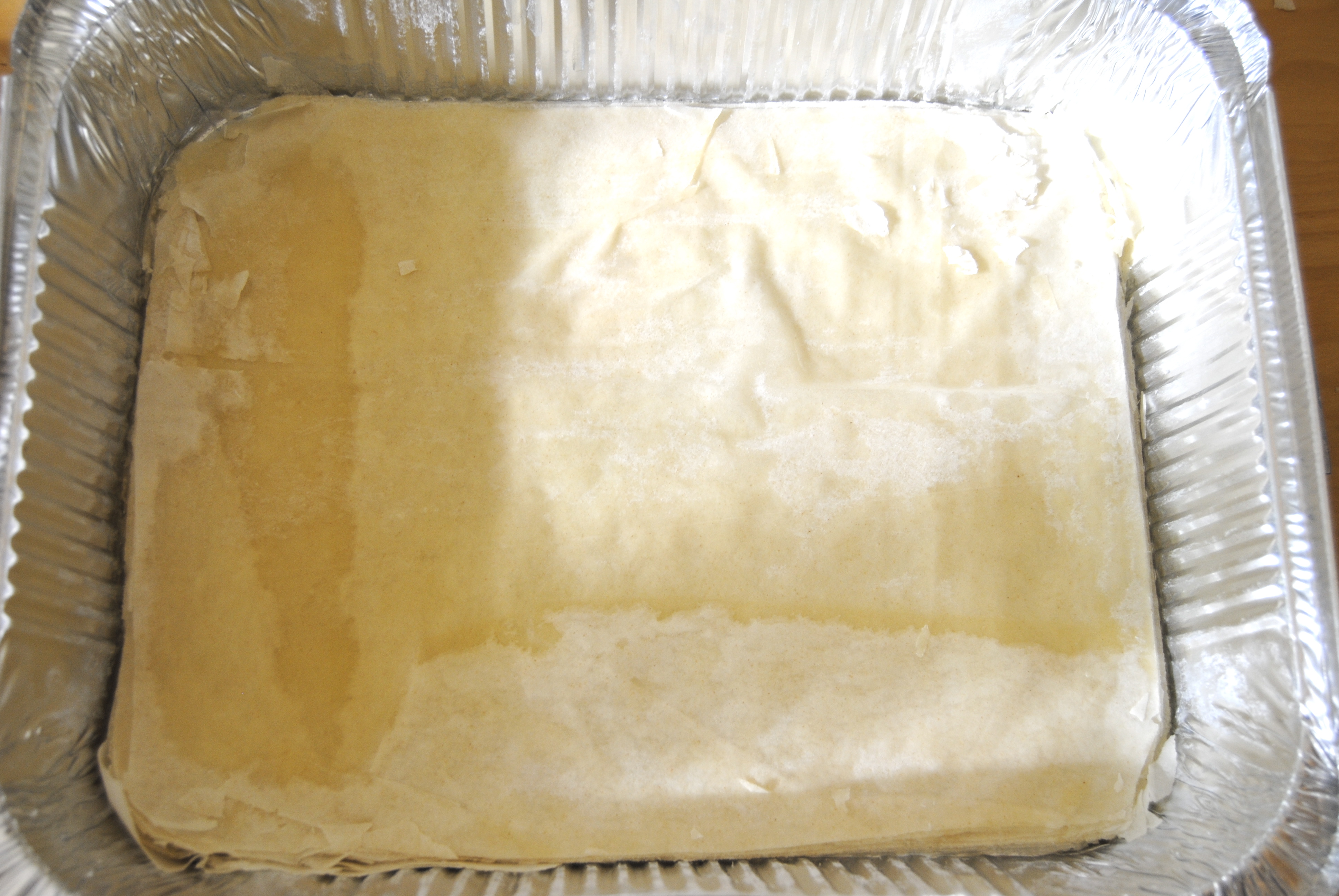
Divide your phyllo dough into two piles: one pile with the first ten sheets we’ll be using and the other with the remaining twelve. Cover the pile with 12 with your damp towel. Place two sheets into your tray, push it into the edges, and layer on some butter. Do it again. And again until you’ve used all ten.

You should have some phyllo dough hanging over the edges. With a knife, trim the hangover pieces and place them under your damp towel. Your phyllo should now look like this:

Now, onto a quick technique I discovered here. Take the scraps that were hanging over and crumple them up like a tissue. You’ll want to try and get as many small balls out of the scraps. If you run out, do the same with one sheet.

Butter this layer generously. Place two sheets of phyllo dough onto the crumbled sheets for a flat surface. Place the nuts onto this flat surface and spread them out evenly.

Cover with the remaining sheets, still two at a time and buttering after every two. Try and conserve some butter, however, for the top coat. Tuck the edges in or trim them away and discard. If I could go back, I would have trimmed more precisely.

Cut three columns down your pan and then cut horizontally to make four rows. You can keep them as squares, or cut each square diagonally.

Butter this top layer and place into the over for 45 minutes, or until the top becomes browned. While that is cooking make your syrup. Bring water and sugar to a boil and let boil for about ten minutes, a little less is fine, too. Then add your lemon, rose water and orange blossom (or not). Give it a stir. Take it off the heat and let cool while the baklava cooks.Pour your syrup into the cracks and crevices of the baklava immediately after this comes out of the oven and listen to that nostalgic snap-crackle-pop sound. You don’t want to pour it on the top because it will get soft and sticky, but if that’s yo’ thang, go ahead. Pouring it only into the cracks and crevices retains the crunch with all the soft gooey insides. Garnish with ground pistachio. *Use about 3/4 c of the syrup and keep the rest for people who want theirs sweeter. Let it sit uncovered for at least one hour. Will keep for three weeks in tuperware.

What you need:

1 1/4 cup of unsalted butter

a fine sieve, cheesecloth or a few coffee filters

How to do it:

For those of us who didn’t go to culinary school, let’s talk about clarified butter (also known as ghee) for a minute. My camera died while I was doing the butter, so sadly, I don’t have the best step-by-step photos, so I’ll try and explain well.

I’m not a butter person at all. I read online that I could buy already clarified butter “from my local Indian grocery store,” like they have those in Jerusalem… so, this was a totally disgusting experience for me: melting the butter, spooning out the foam (reading that someone suggested I store it in my fridge?!) and the straining it. Clarifying butter removes the milk solids and moisture, which allows you to cook it at higher temperatures and for longer amounts of time (which is good in Persian or Indian cooking, and probably a lot others). Sometimes it’s called for in baking as well, like with Baklava. You’ll lose about 25 percent of the butter in this process, which is why the ingredients call for 1 1/4 cup butter, though you will really only use 1 cup. If you’re nervous for health reasons, use 1/2 cup of oil and 1/2 cup of the clarified butter. Onwards.

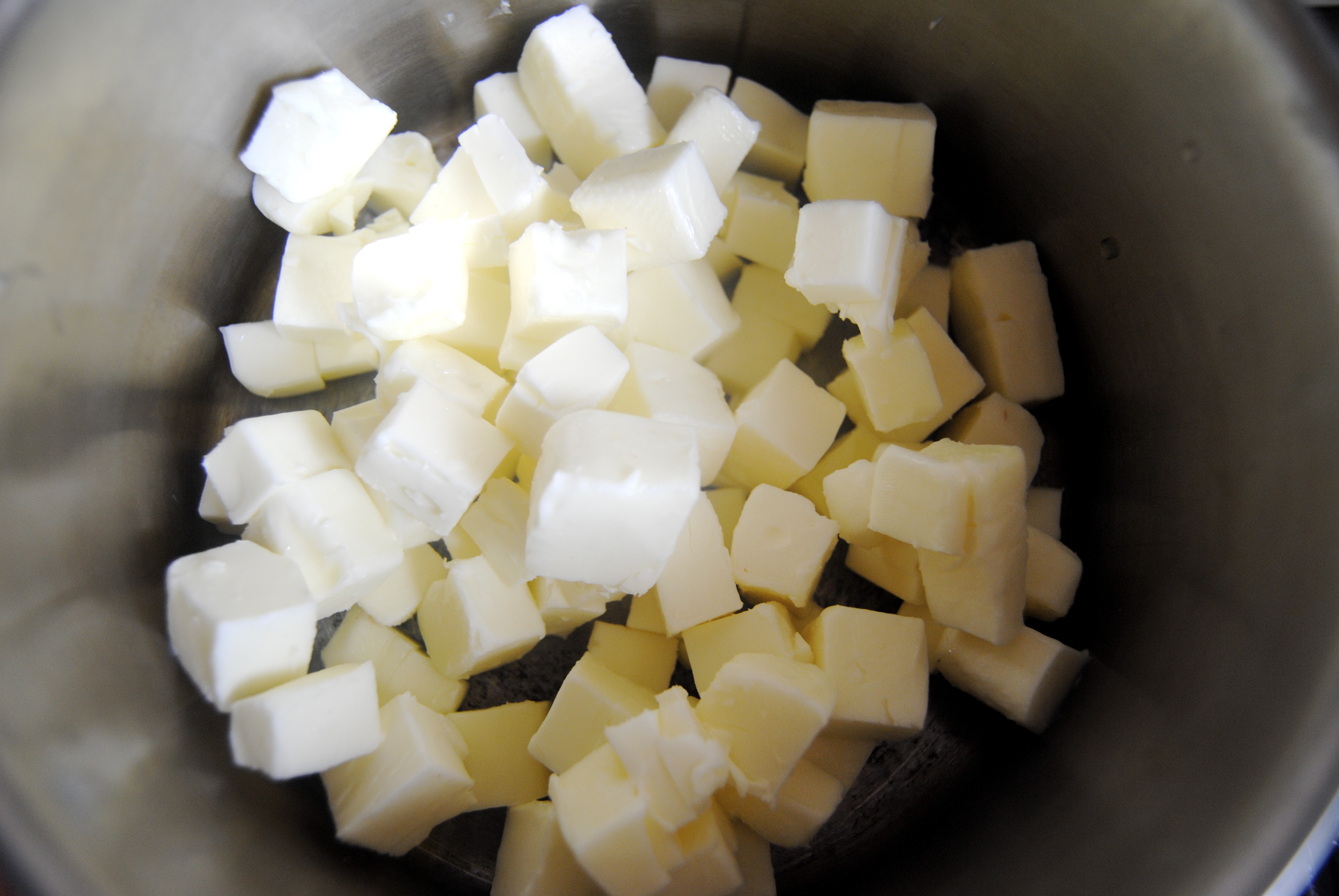
Cut the butter into cubes and simmer over very low heat until all the butter is melted.

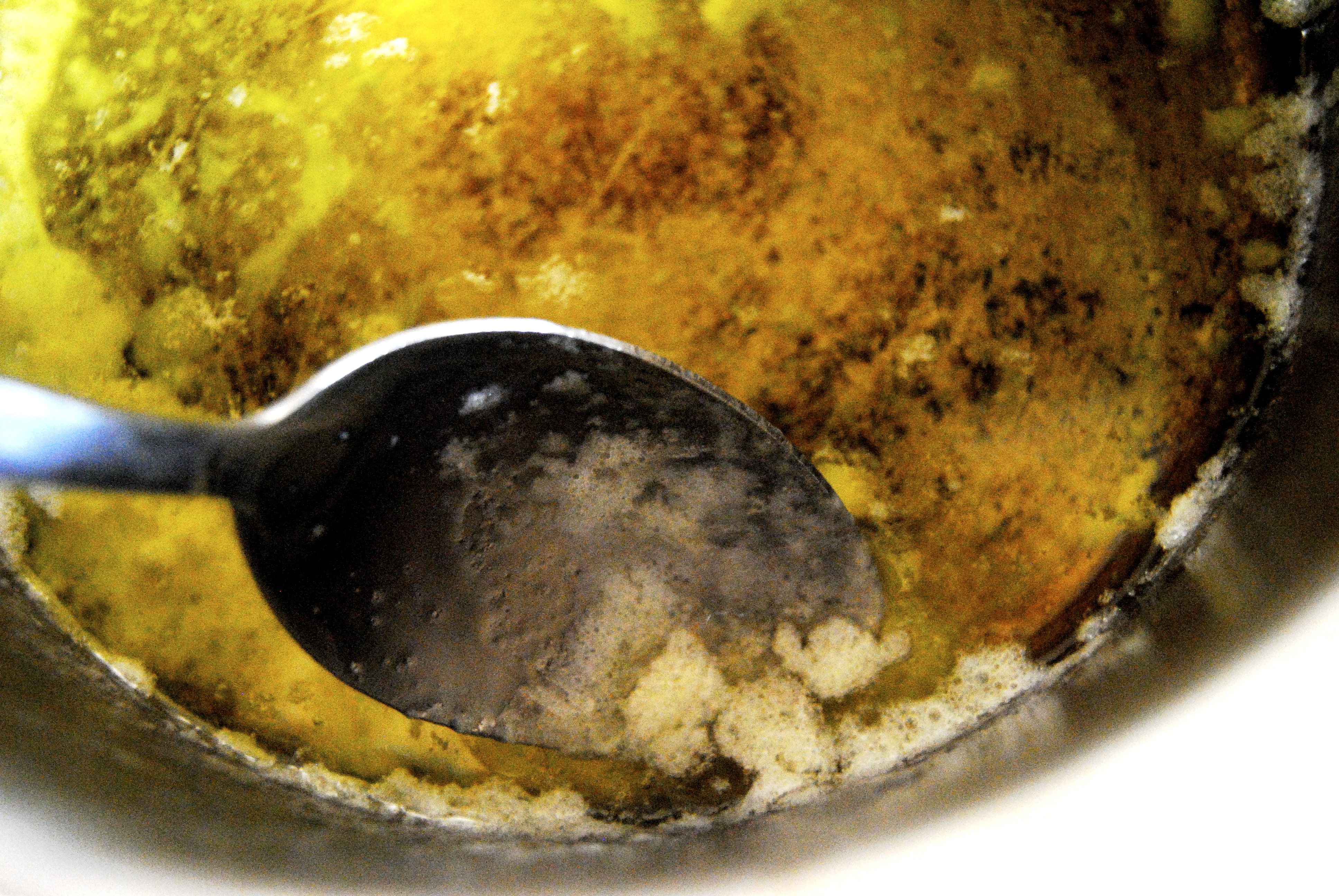
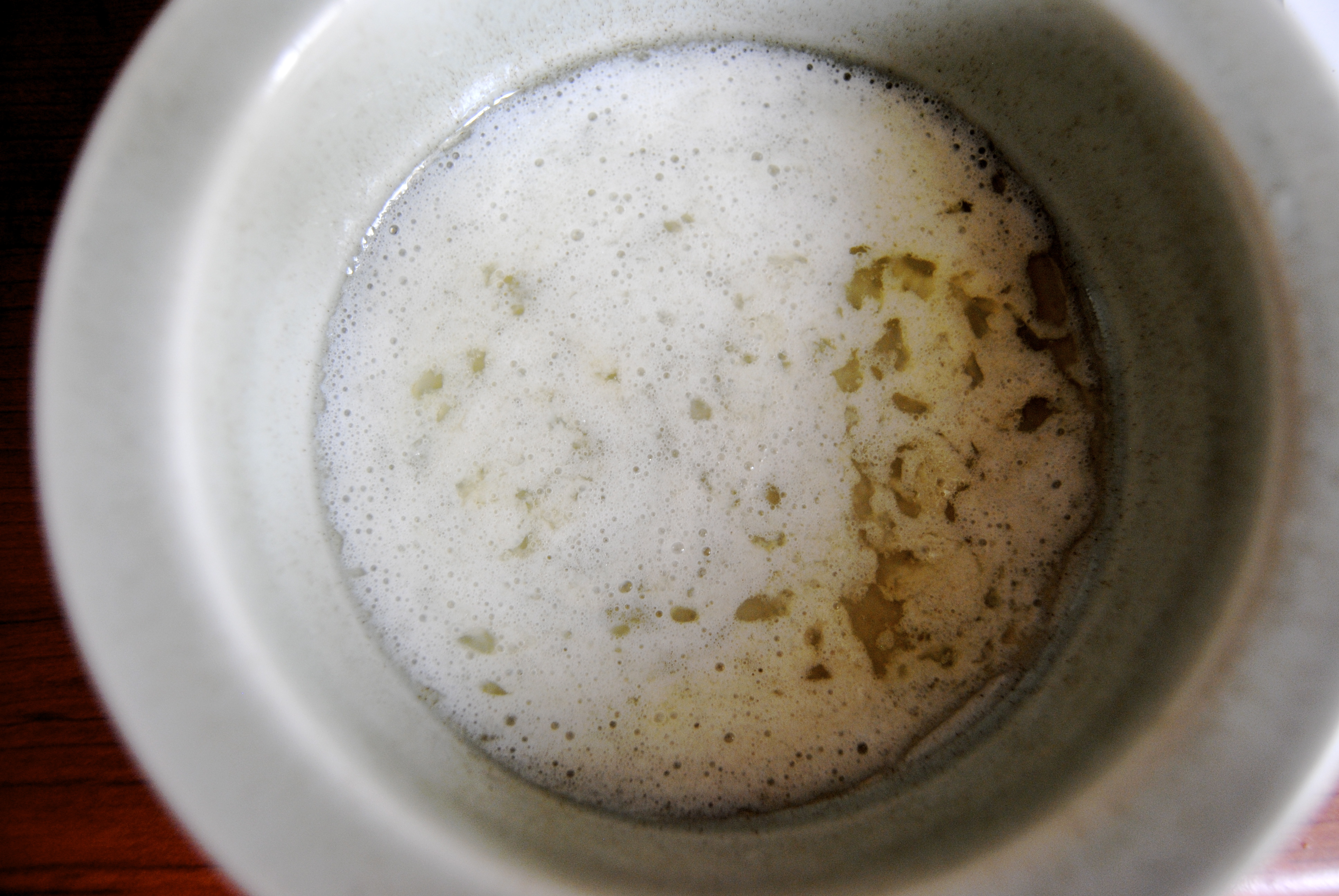
A lot of foam will begin to rise to the top. Once the foam stops rising to the top (about five minutes), remove the pot from the heat and skim off as much of the foam as you can with a spoon.

You can use this for later cooking or you can gag at the thought of doing so and throw it in the garbage, like me.

Next, strain the remaining butter through a sieve or thick paper towel. I used a coffee filter because I didn’t have a fine enough sieve. A cheesecloth would have worked wonders for me. I thought this part was unnecessarily tedious, so buy clarified butter if you can. Otherwise, buy a cheesecloth. Try not to lose too much butter in the process though, like I did. Bottom line, you just don’t want the white globs, so it’ll all be okay if you don’t strain it perfectly well, or at least it’ll all be okay with me 😉

Also, you can add spices at this point to make flavored clarified butter, such as, cardamon-flavored butter, ginger-flavored and even jalapeno. Here are some proportions if you’re interested in that (though I didn’t go that route).

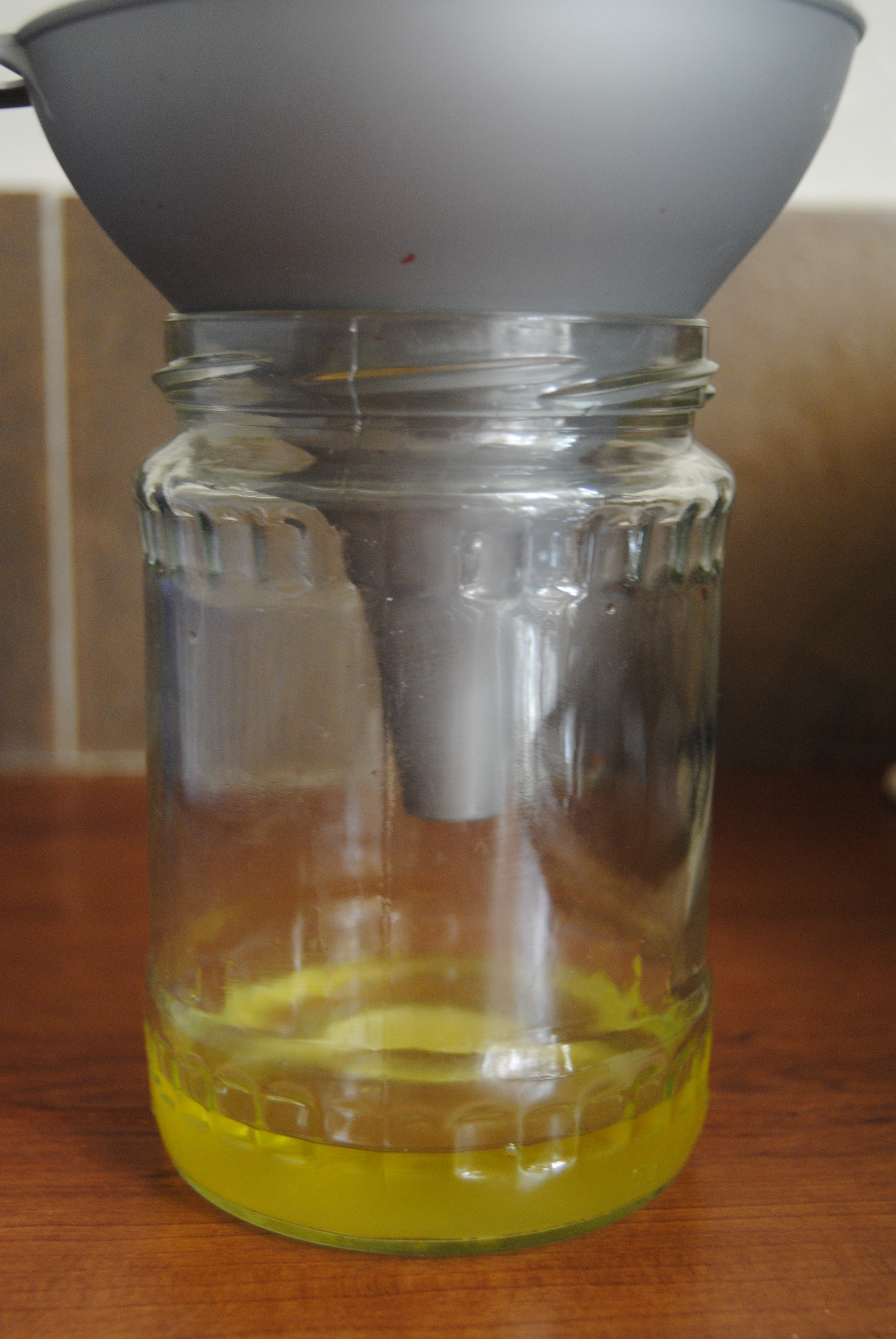
This is the color that you want. Pour it into a tightly-lidded jar. It will keep in your fridge for up to a year. Just warm it up in a pot before using.

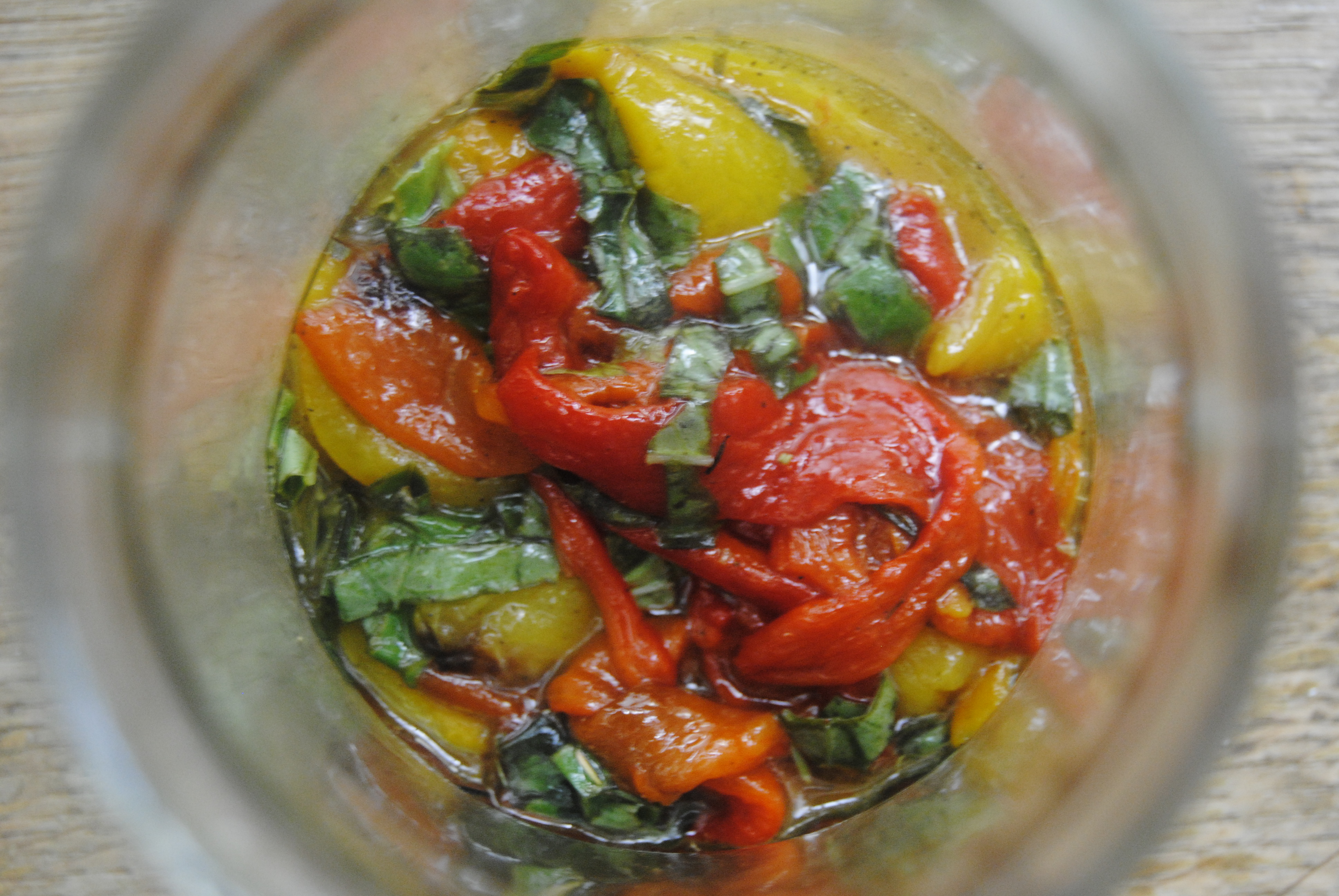
The other day, my friend was roasting peppers, eggplant, zucchini and onions and it sent me back to being in middle school, sitting on friend’s porch, eating Shabbat leftovers, and pouring roasted peppers on challah bread into our mouths as we giggled our little tushies off. I had to make some. So, I made two kinds: one that marinated in basil, olive oil, lemon, thyme and salt and the other that marinated in pomegranate syrup, lemon juice and honey. It was fun to try something new, but these are also delicious with just oil, thyme and a little salt. Also, while all sorts of colors look pretty, it was significantly more time-consuming to peel the peppers that were not red, while the red peppers peeled in seconds. If time is an issue for you, you’ll want to factor that in. And if you are squeamish about germs, forget it all together. Just looking at a roasted pepper you know someone’s hands have been ALL over it!

What you need:

2 red peppers

1 yellow pepper

1 orange pepper

bowl #1

2-3 tblsp oil of your choosing

a handful of basil; chopped into long threads (described below)

salt to taste

1/2 tsp dried thyme (or fresh would be fine)

1-2 tblsp lemon

bowl #2:

1/3 cup pomegranate syrup

1/3 cup water

1 tsp oil of your choosing

1 tsp lemon

What to do:

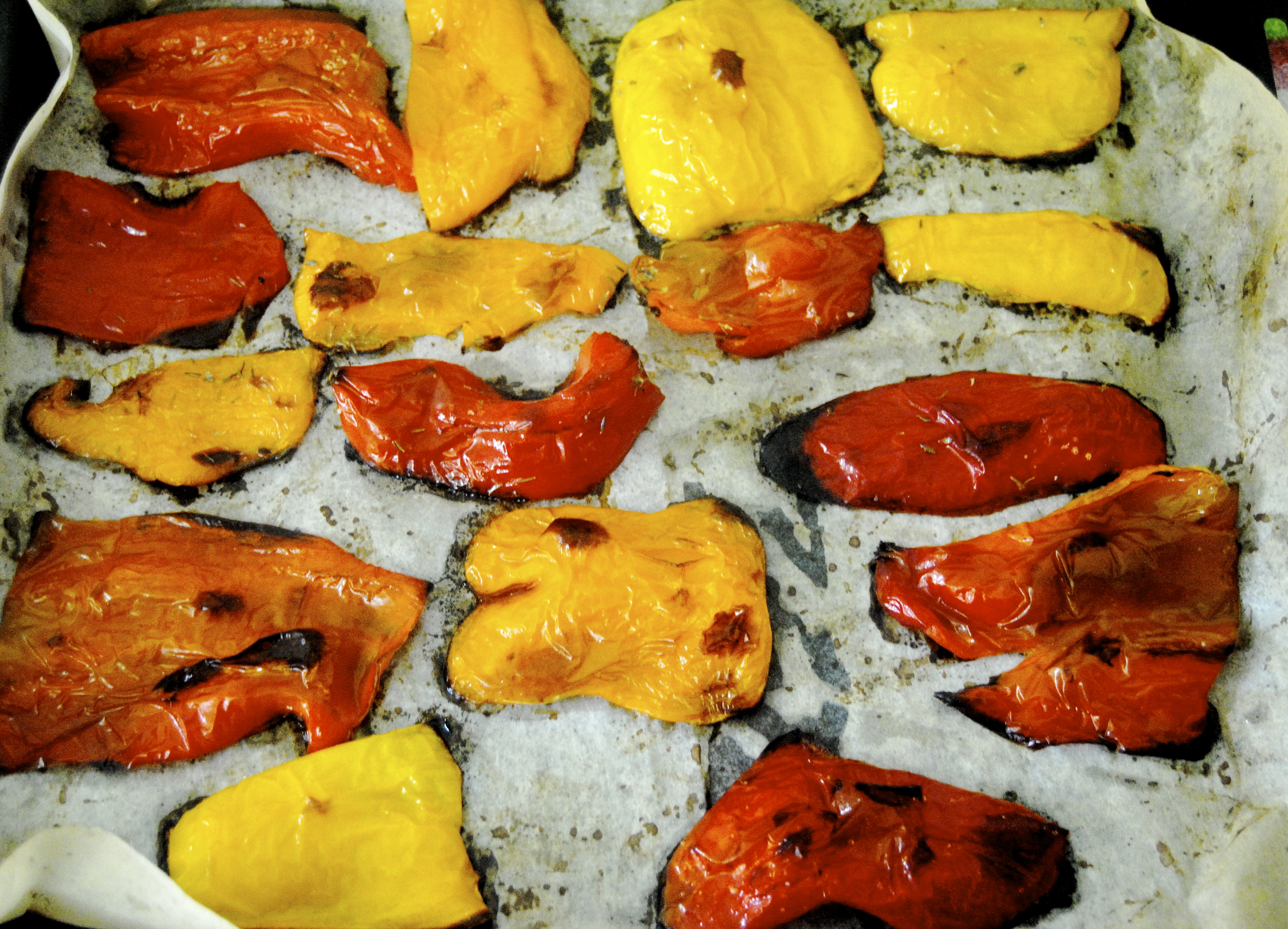
Preheat your oven to 500 F. Slice peppers on all four sides, throw them into a bowl and toss some of them with some oil, thyme and salt and toss the others with just oil (these will be used for the pomegranate marinade). Then, lay them skin-side up on parchment paper on a tray like this:

While these roast, prepare your marinades in two bowls. Roast the peppers until their tops are black, or about 35-40 minutes. They should look like this, or even a little darker:

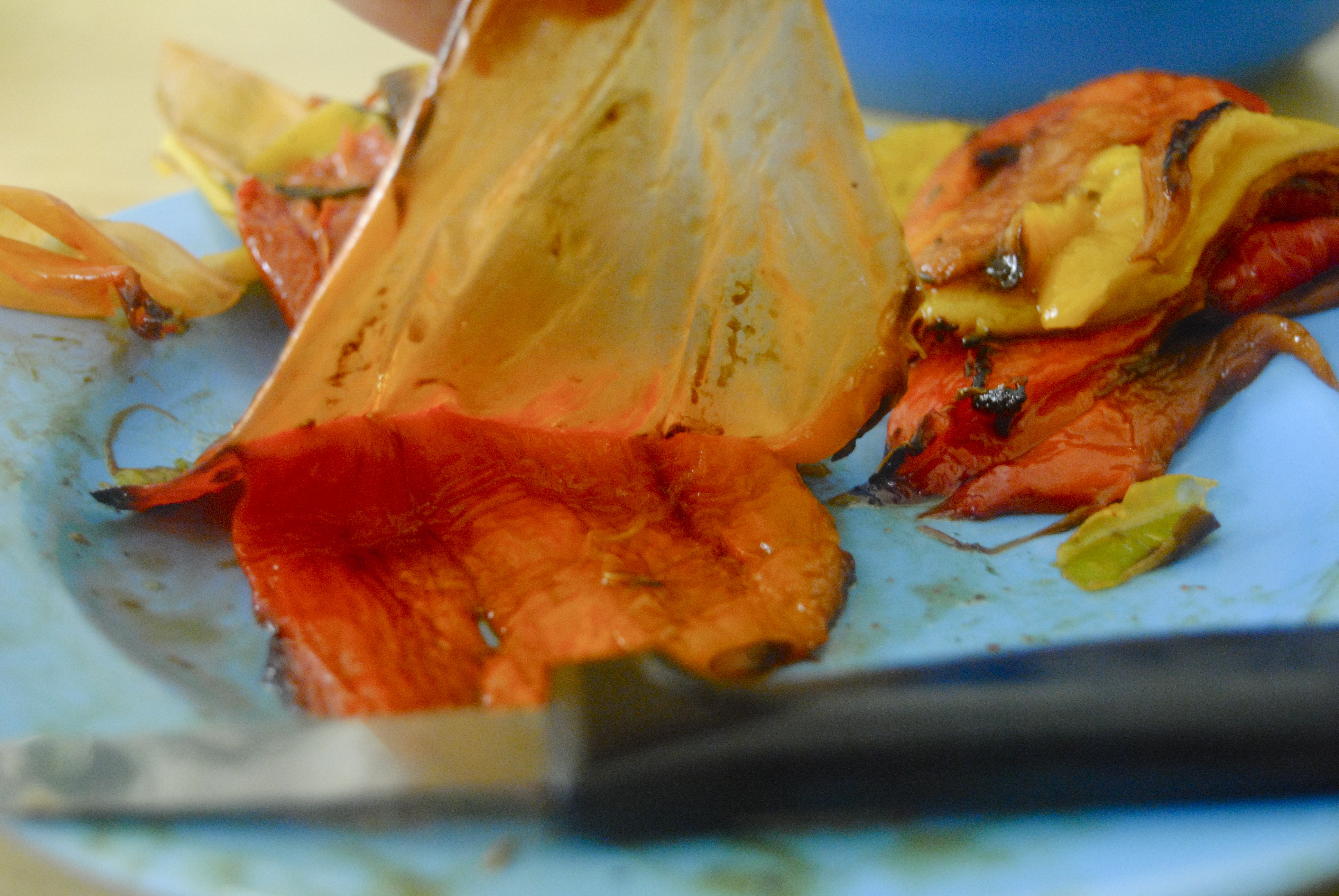
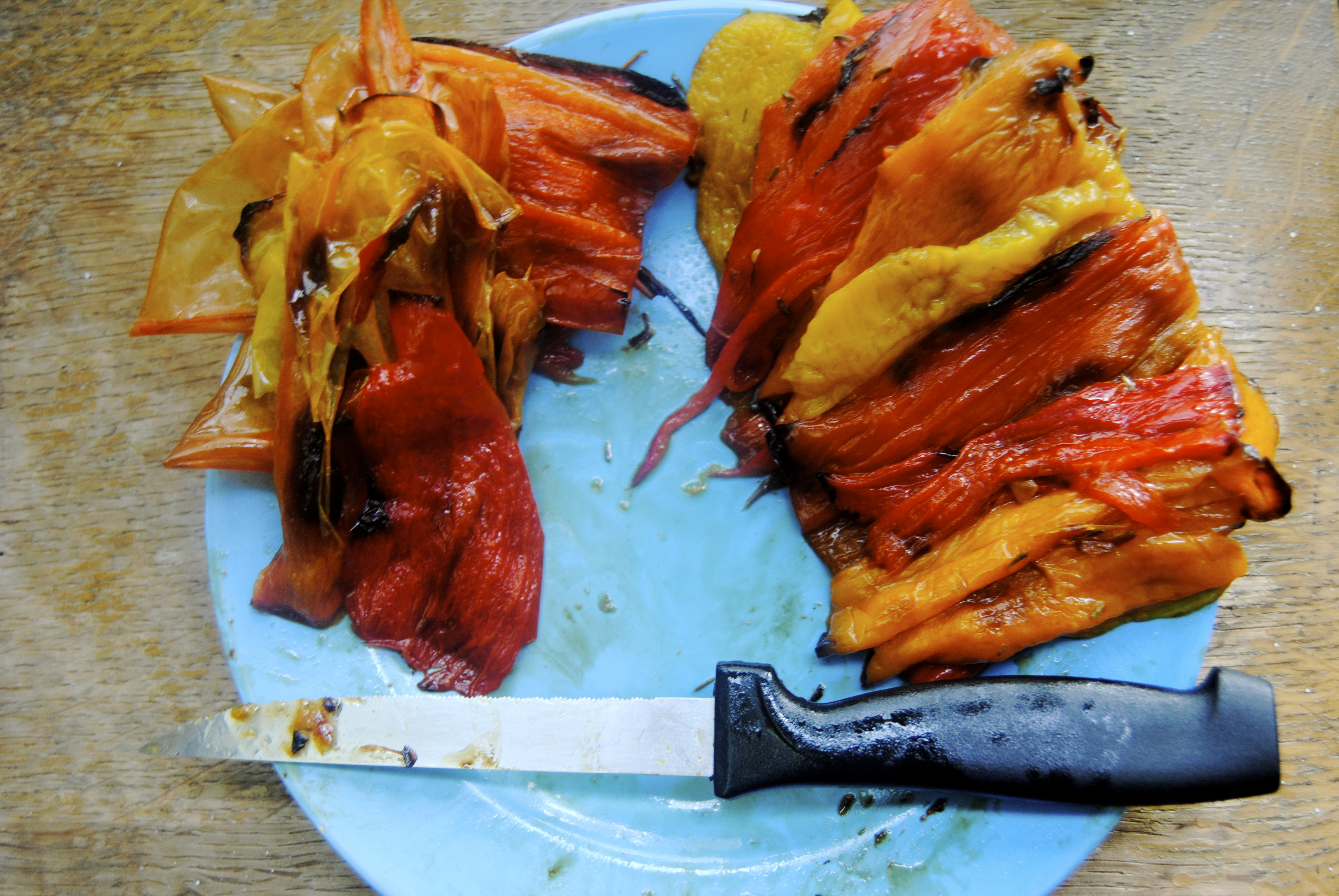
Next, you’ll want to throw them directly into a paper or plastic bag, or into a bowl and cover it with cling wrap. We’re going to steam them for about 15 minutes to get the skins a little looser and peel away like this:

Once you’ve peeled all your peppers, you can take the fleshy parts that you’re saving and slice them the long way into strips. Be ware though, this is messy business, folks.

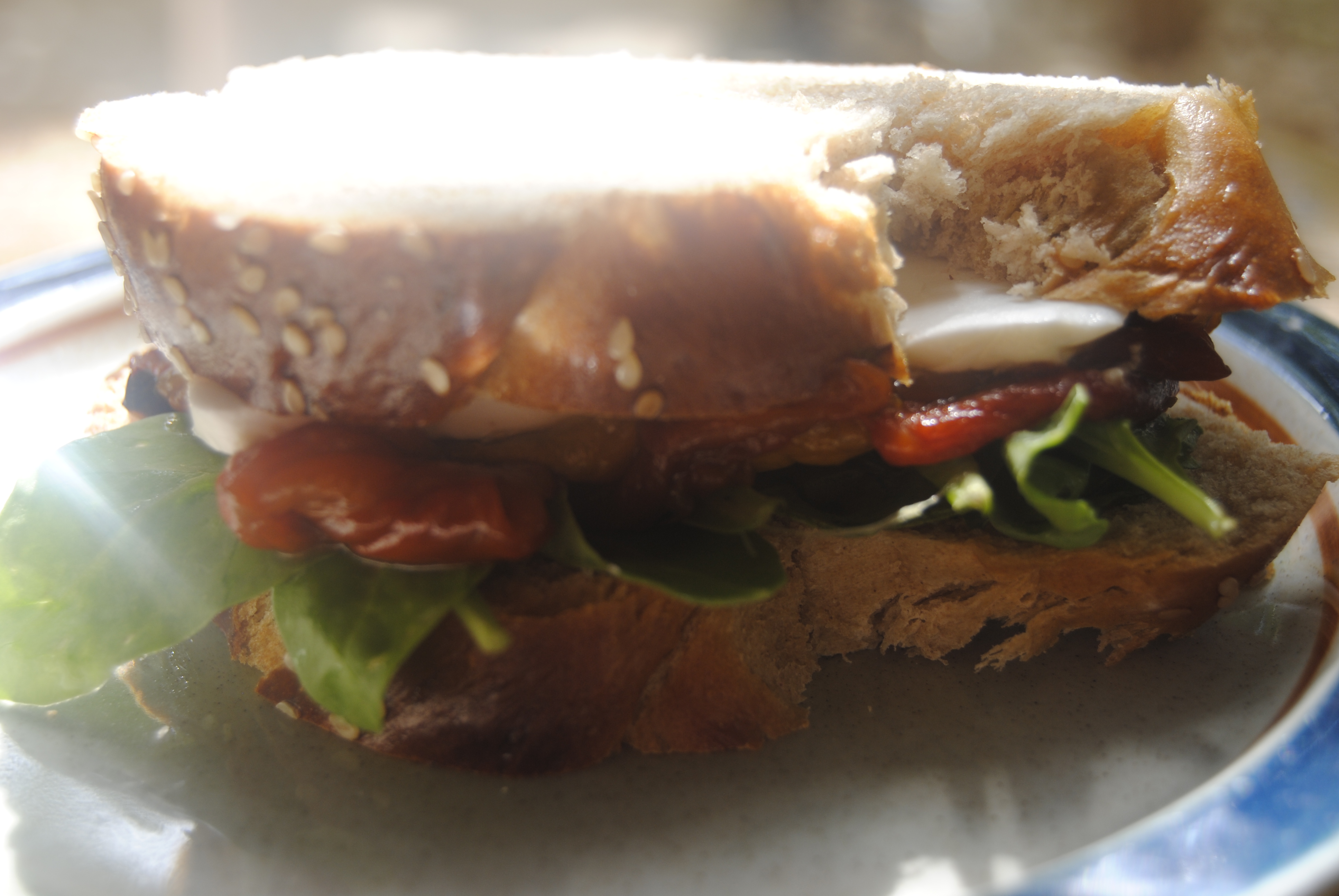
Then you can put them in the marinade(s) of your choosing for about 15 minutes. Cut the basil into strips by stacking all the leaves, rolling from one side over to the next and then begin cutting. Store peppers in a jar or ziplock (with some oil) and save to put on salads, serve as an appetizer or put inside a goat cheese, spinach and challah bread sandwich like this: 

I promise we’ll do challa bread soon, too, like next Friday morning when I make it for Shabbat dinner. Enjoy!

This is a really yummy dinner you can pull together in 20 minutes. Let’s start with the salad.

Serves: 2-3
What you need:

1 can of chickpeas, or an equivalent amount that you’ve soaked overnight and boiled

4 stalks of lettuce; sliced into 1″ pieces

1/4 red onion; chopped

1 tsp lemon; zested

1 tsp of ginger; grated

1/2-1 cup of mint; chopped (depends on how much you like mint)

2 cups of spinach

oil for frying

salt & pepper to taste

1 tblsp of yogurt tehina

sumac to sprinkle

How to do it:

On low heat, fry the chickpeas with oil for a few minutes, making sure not to let the chickpeas burn. After a minute or two, add the celery and a little more oil, if necessary.

After about ten minutes, add the salt, pepper, lemon and ginger. Saute together for another five minutes, or so, and then throw in the onion. Lay a bed of spinach on a plate and pour a generous amount of the chickpea & celery salad on top of the spinach. Top it off with a dollop of yogurt tehina and sprinkle some sumac all around. Enjoy!

Miso Soup

This was a simple miso soup to prepare and came together really fast when we were rushing to make dinner the other night. We used an organic miso paste from barley primarily because everything else is the specialty Asian store here had MSG. If you can find it without though, go ahead and substitute any miso paste with the barley one we used.

Serves: 4-6

What you need:

4 tblsp miso paste (this is really to your taste though)

8 cups water

3 oz firm tofu; chopped into cubes

1 green onion; sliced into coin slivers

1/3 c cilantro (you could use parsley if you hate cilantro)

2 cups egg noodles

1 tblsp soy sauce

4 mushrooms; sliced thinly

1/4 yellow onion; sliced thinly

How to do it:

Bring water to a boil and cook the egg noodles for three or four minutes with salt. Drain and run cold water over them to stop them from cooking further. Set aside.

Bring water to a boil, reduce it to a simmer and take it off of the burner. In a small bowl, pour about 1 cup of water and mix in your miso paste, stirring gently to incorporate all the clumps. But your pot back on the heat, stir the miso & hot water  into the pot and add your tofu, onions and mushrooms. Let cook for a minute and then remove from the heat. Add the soy sauce and salt (if it needs it) and let it sit for a minute. Put noodles into the bottom of several bowls and pour the miso, tofu, mushrooms and onions over the noodles. Enjoy!

Mama Rice: pronounced “Muh-Muh”

I think many of us have that one dish that reminds us of home, where as instantly as you smell it you are reminded of how it felt to be squeezed by the safety of your grandmother’s body. So naturally, sharing this dish feels like much more than sharing food. This dish gets its name from my great-grandmother, Mama, and was passed on to me by my grandma’s sister, Gabo. We have lots of cutsie names in my family. Go with it. Mama rice instantly sends me back to childhood: standing in the rain because it was exhilarating, tirelessly playing four-square with bloody knees and hands, and just living without a care in the world.

This is the first time I’ve ever made Mama Rice, and I suppose it is somewhat of bench mark. I don’t remember the last time I walked out in the rain to intentionally get wet, and my last game of four-square was well over ten years ago.

Mama isn’t alive anymore to cook Mama Rice for our family, but taking on this recipe myself means that I’m an adult now and it is my responsibility now to share those feelings of comfort, security and warmth with you as Mama shared with all of us.

And it’s no small factor that it happens to be INSANELY delicious and highly addictive.

Serves: 4-5

What you need:

2 cups basmati rice

1 tsp cinnamon

1 cup fresh green beans; cut into two inch pieces

1/2 cup tomato paste

1 small onion

1/2 lb ground beef or veal

salt for seasoning

How to do it:

I’m not going to get into the knitty gritty of Persian rice preparation. Persian rice requires patience, care and can be very tempermental, even for experienced cooks. Dare I say Persian rice is an awful lot like a woman? Feminists: deep breath. I will say that it helps to soak your rice in water with a little salt for an hour or a few hours before cooking it. If you can’t, then don’t. Nothing will happen. But it’s part of the method and ends up being fairly important when you want to make more impressive rice dishes (which we’ll do!). What you must do, however, is wash the rice until the water runs clean. This means washing it about three or for times, swishing the rice around with your hand and draining.

When your rice has finishing soaking, start with the meat. Heat up your oil on low, as always in Persian cooking, and finely dice  your onion. Add the meat and break it into little pieces with your spatula until it looks cooked.

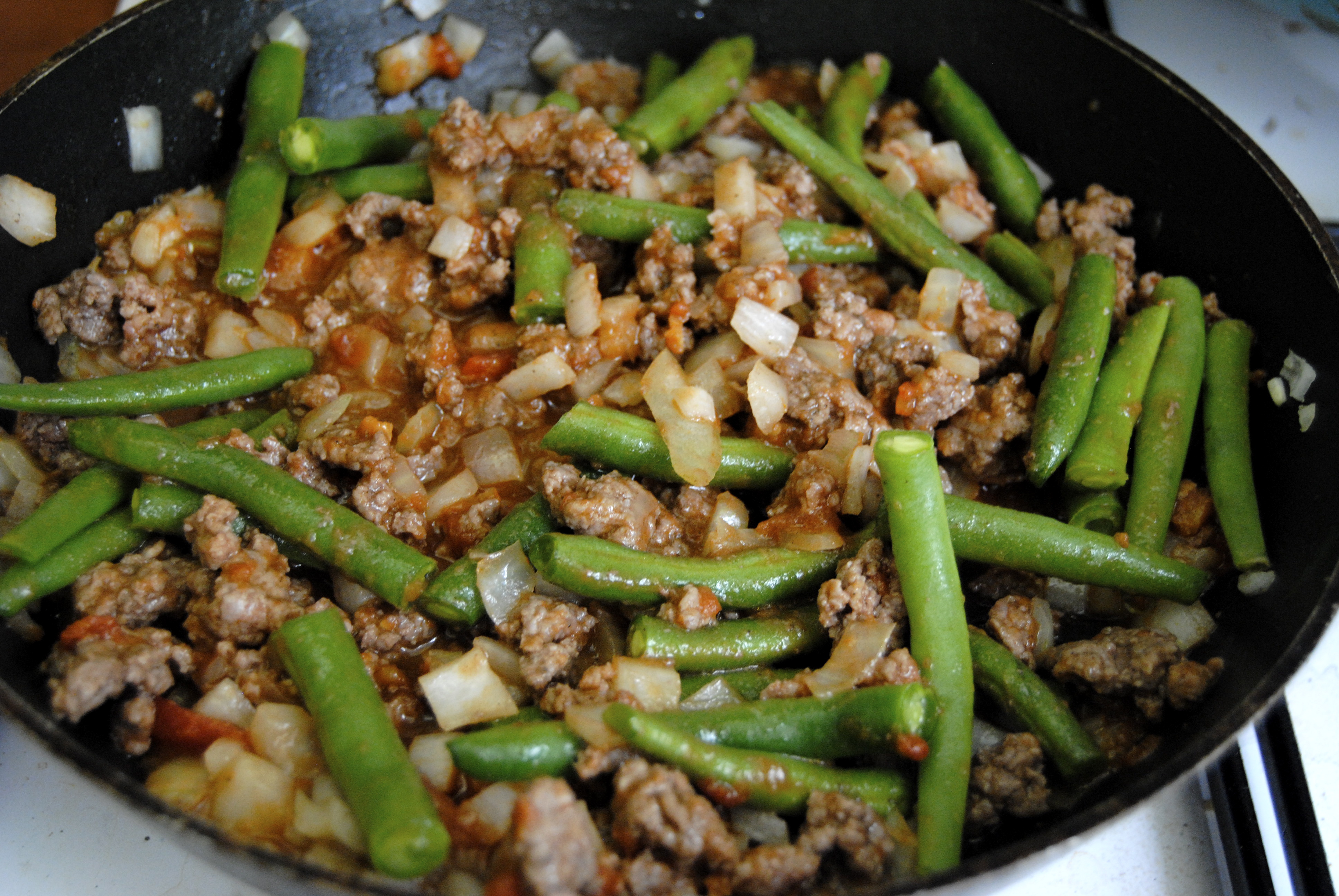
Once it looks cooked, add your tomato paste, green beans and cinnamon and combine well. Set aside.

In a pot, add your rice, a little oil and some salt.

4 cups of water for 2 cups of rice, got it? When the rice is half-way cooked (after about ten minutes) and most of the water is absorbed, add the meat and vegetable mixture and combine very well. It is finished when all the water is absorbed.

Very important: stick your face into the pot and smell. How incredible is that?!

As Gabo says, this is a full meal on its own. I hope you enjoy it!